|
The Hockey Health Brief
After Hip Arthroscopy:
What Hockey Players Need Before Returning
Why return to skate is not the same as return to play
|
|
|
A hockey player may be able to skate laps without pain and still not be ready to play.
That is the problem.
After hip arthroscopy, return to hockey is not just about getting back on the ice. It is about rebuilding the capacity to handle what hockey demands: stride length, edge work, hip rotation, acceleration, deceleration, shooting, contact, fatigue, repeat shifts, and the next-day response.
Pain-free skating is a milestone. It is not the finish line.
A player may feel better, get back on the ice, and look decent in a controlled setting. Then hockey gets faster, heavier, more chaotic, and more fatiguing. That is where the gap shows up.
|
Why This Matters for Hockey Players
The good news is that return-to-sport rates after hip arthroscopy in hockey players are encouraging.
Barda et al. reported an 86.9% return-to-sport rate, with 74.5% returning at the same or higher level. At 10 years, 57% were still playing hockey. [1]
Slawaska-Eng et al. found an overall 79.3% return-to-sport rate in NHL players, rising to 84.9% when excluding players still recovering. [2]
Baker et al. reported an 84% return-to-sport rate for hockey athletes in a professional multi-sport cohort. [3]
Most hockey players can get back. But getting back well takes more than time, symptom relief, and a few easy skates.
|
Hockey Is Different
Hockey is not a straight-line sport. The skating stride repeatedly places the hip into flexion, adduction, internal rotation, abduction, extension, and external rotation. Add in crossovers, tight turns, stops and starts, puck protection, contact, and repeated shifts, and the hip is asked to tolerate a lot.
Silvestri and colleagues describe femoroacetabular impingement in ice hockey athletes through the lens of skating biomechanics, including repetitive hip flexion, internal rotation, and adduction demands. [4]
Hockey Health Takeaway: A hockey hip does not just need to feel good. It needs to tolerate hockey.
|
Time Matters, But Time Alone Is Not Enough
A common mistake after hip arthroscopy is thinking, “I am 2 months out, so I can skate,” or “I am 6 months out, so I can play.”
Time matters. Healing matters. Surgical guidance matters. But time alone should not make the return-to-play decision.
A better question is:
What can the athlete tolerate?
The hip does not only need to feel good during the skate. It needs to respond well after the skate. If a player skates on Monday and has hip flexor irritation, groin soreness, pinching, or low back compensation on Tuesday, that is useful information.
|
Return to Skate vs. Return to Play
Return to skate is a step. Return to play is a process.
| Phase |
What It Means |
What It Does Not Mean |
| Return to Movement |
Walking, early mobility, early strength, basic control |
Ready to skate |
| Return to Skate |
Controlled skating, low intensity, early puck work |
Ready for practice |
| Return to Practice |
Drills, speed, direction change, controlled contact |
Ready for games |
| Return to Play |
Full hockey demands, contact, fatigue, repeat shifts, game speed |
Done with rehab |
Return to skate means the athlete has started the hockey progression. It does not mean they have finished it.
|
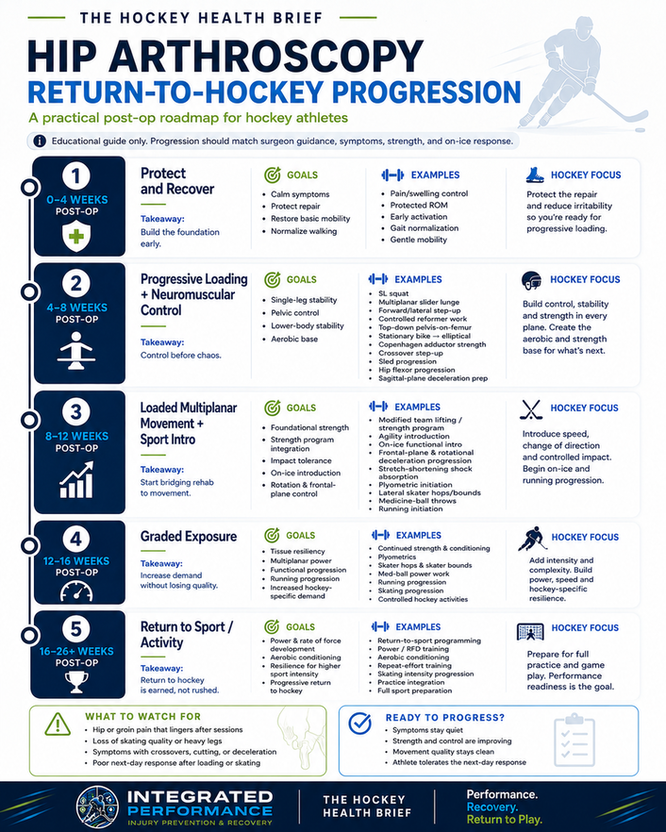
Hip Arthroscopy Return-to-Hockey Progression
|
A Roadmap, Not a Race
The progression is not meant to be a rigid calendar. Some athletes move faster. Some move slower. Surgical findings, surgeon preference, symptoms, strength, confidence, skating response, season timing, and prior injury history all matter.
The goal is not to “hit the next phase.” The goal is to earn the next phase.
- Symptoms stay quiet
- Strength and control are improving
- Movement quality is clean
- Skating quality is not breaking down
- The athlete tolerates the next-day response
|
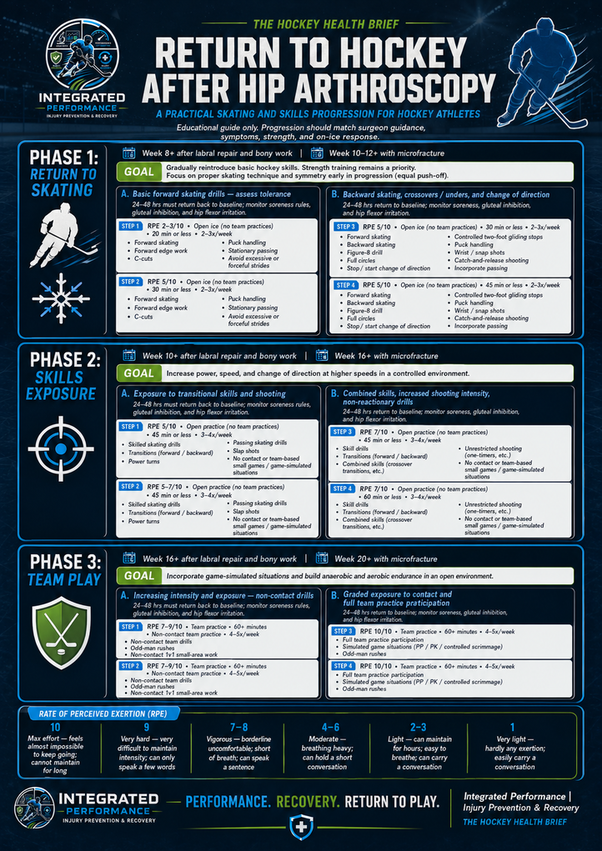
Return to Hockey After Hip Arthroscopy
|
How the Skating Progression Fits
Phase 1: Return to Skating
Start with forward skating, edge work, C-cuts, basic puck handling, controlled passing, and gradual addition of backward skating, crossovers, figure-8s, and direction change.
Phase 2: Skills Exposure
Add transitional skating, shooting, power turns, passing drills, combined skating and puck skills, and more hockey-specific movement patterns.
Phase 3: Team Play
Progress toward non-contact team practice, odd-man rushes, small-area work, simulated game situations, graded contact exposure, and full practice participation.
Return should move from controlled skating → controlled skill work → controlled team exposure → full return.
|
What Hockey Players Need Before Returning
Strength: hip flexors, adductors, glutes, trunk, and single-leg strength.
Control: pelvis, trunk, and hip control during single-leg and lateral tasks.
Power: ability to produce and absorb force for acceleration, deceleration, and skating mechanics.
Skating tolerance: forward skating, backward skating, crossovers, stops and starts, edge work, and repeated bouts.
Hockey demands: shooting, puck handling, reactive drills, team flow, contact progression, and practice intensity.
Next-day response: the athlete should respond well later that day, the next morning, and after repeated sessions.
|
What to Watch For
- Hip or groin pain that lingers after sessions
- Loss of skating quality or heavy legs
- Symptoms with crossovers, cutting, or deceleration
- Poor next-day response after loading or skating
These are not reasons to panic. But they are reasons to pay attention. Repeated symptoms are information. Use them. Adjust the dose. Do not just keep pushing.
|
Key Takeaways
Return to skate is not return to play.
Pain-free skating is a milestone. It is not the finish line.
The hip needs to tolerate skating, shooting, contact, fatigue, and repeat shifts.
The next-day response matters.
Cleared does not always mean prepared.
|
Final Thought
Hip arthroscopy can help hockey players get back to the sport they love. The research is encouraging, and return rates are generally strong. [1–3]
But the goal is not just getting back on the ice. The goal is getting back to hockey.
Pain-free is not the finish line. Prepared is the goal.
|
This Week’s Challenge
If you are a player, parent, coach, or clinician working through return to hockey after hip arthroscopy, ask this:
What hockey demand has the athlete not yet earned?
Is it crossovers, shooting, contact, repeated shifts, practice volume, game speed, or the next-day response? Find the missing step. Then build toward it.
|
References
- Barda SR, Quesada-Jimenez R, Moore WM, et al. Clinical outcomes and return to sport after hip arthroscopy in ice hockey players: minimum 2-year results with mid- and long-term subanalysis. American Journal of Sports Medicine. 2026. doi:10.1177/03635465261448492.
- Slawaska-Eng D, Bouchard MD, Del Sordo L, Weber AE, Ayeni O. Performance and return to sport outcomes following hip arthroscopy in National Hockey League players. Knee Surgery, Sports Traumatology, Arthroscopy. 2025. doi:10.1002/ksa.12720.
- Baker HP, Capitano A, Uvodich ME, et al. Return to sport and outcomes after hip arthroscopic surgery for treatment of femoroacetabular impingement in professional athletes. American Journal of Sports Medicine. 2025. doi:10.1177/03635465251393258.
- Silvestri MA, Cleather DJ, Patterson S, Legg HS. Femoroacetabular impingement in ice hockey athletes. Journal of Strength and Conditioning Research. 2023;37(10):2106-2117. doi:10.1519/JSC.0000000000004531.
- Boos AM, Wang AS, Lamba A, et al. Long-term outcomes of primary hip arthroscopy: multicenter analysis at minimum 10-year follow-up with attention to labral and capsular management. American Journal of Sports Medicine. 2024;52(5):1144-1152. doi:10.1177/03635465241234937.
- Allahabadi S, Chapman RS, Fenn TW, et al. Hip arthroscopic surgery with chondrolabral refixation, osteochondroplasty, and routine capsular closure for femoroacetabular impingement syndrome: clinical outcomes at a minimum 10-year follow-up. American Journal of Sports Medicine. 2024;52(1):24-33. doi:10.1177/03635465231212663.
- Lee MS, Kim DNW, Moran J, et al. Patients undergoing primary hip arthroscopy report favorable outcomes at minimum 10-year follow-up: a systematic review. Arthroscopy. 2023;39(2):459-475. doi:10.1016/j.arthro.2022.10.040.
- Nho SJ, Beck EC, Nwachukwu BU, et al. Survivorship and outcome of hip arthroscopy for femoroacetabular impingement syndrome performed with modern surgical techniques. American Journal of Sports Medicine. 2019;47(7):1662-1669. doi:10.1177/0363546519843936.
- Champagne G, Dartus J, Pelet S, Matache BA, Belzile EL. Patient factors influencing outcomes at 12-year follow-up of hip arthroscopy for femoroacetabular impingement. American Journal of Sports Medicine. 2024;52(10):2586-2595. doi:10.1177/03635465241265721.
|
|
See you on the ice,
Jeremy O’Keefe, PT, DPT, SCS, CSCS
Integrated Performance
|
|
You are receiving this email because you subscribed to The Hockey Health Brief.
Practical hockey health, performance, injury prevention, and return-to-play guidance from Integrated Performance.
Unsubscribe
|
|