|
Summer hockey can be sneaky.
There may be fewer games, but many players are still skating, lifting, shooting, training, attending camps, playing other sports, traveling, and staying up later than usual. Add in hot weather and inconsistent routines: recovery can quickly become the missing piece.
For hockey players, recovery is not just about feeling less sore. It is about giving the body enough support to adapt to training, reduce fatigue, and stay healthy once the season gets busy and skating volume increases.
|
That starts with two simple habits:
Sleep enough.
Stay hydrated.
|
These habits are not flashy. But they can have a major impact on how a player feels, trains, recovers, learns, and performs.
An injury-free season does not start on the first day of tryouts. It starts with the habits built in the summer.
Recovery = Training Gains
Training creates stress. It is purposeful.
Recovery is where the body adapts to that stress.
That is an important difference. Skating, lifting, sprinting, shooting, and conditioning all challenge the body. But the actual improvement happens when the athlete has enough time and resources to adapt.
For hockey players, this matters because the season is long. The body has to tolerate repeated skating, cutting, battling, shooting, travel, school, tournaments, and strength training. If recovery is consistently poor, players may still be able to train, but they may not be adapting as well as they could.
Over time, poor recovery can show up as:
- More soreness than usual
- Slower skating or heavy legs
- Poor focus
- Reduced motivation
- Sickness
- Feeling run down during busy training weeks
This does not mean every injury is caused by poor recovery. It does mean that sleep and hydration should be treated as part of the training plan.
|
Simple takeaway:
Recovery is not separate from training. Recovery is what allows training to work.
|
Sleep: The Most Powerful Recovery Tool
Want a quick fix? Focus on sleep quality and quantity.
Sleep supports physical recovery, learning, attention, reaction time, mood, immune function, and overall health. For youth athletes, it is also closely tied to growth and long-term development.
So, that magic pill every athlete is looking for to get better?
You found it.
A review of young athletes found that insufficient sleep is common in athletes ages 14–25 and may affect injury risk, recovery, and performance. The review also highlighted that young athletes getting less than 8 hours of sleep per night have a higher musculoskeletal injury risk. [3]
Another systematic review and meta-analysis in adolescent athletes found that chronically poor-sleeping adolescents had 1.58 times greater odds of injury. Meaning about 58% greater risk. [4]
That does not mean one bad night of sleep causes an injury. Life happens. Tournaments run late. Travel gets messy. School and summer schedules change.
But if poor sleep becomes the pattern, the athlete may have a harder time recovering from the demands of training.
How Much Sleep Do Hockey Players Need?
Here is a simple sleep chart families can use as a starting point.
| Age |
Recommended Sleep Per Night |
Hockey Player Takeaway |
| 10–13 years old |
9–11 hours |
Build a consistent bedtime routine now. Young athletes need sleep to support growth, learning, and recovery. |
| 14–17 years old |
8–10 hours |
Protect sleep during heavy training weeks, tournaments, late-night screen use, and growth spurts. |
| 18+ years old |
7–9 hours |
Adult athletes still need consistent sleep to recover, train, and perform well. |
Hockey Health Takeaway:
For youth hockey players, aim toward the higher end of the range during heavy training weeks, tournaments, growth spurts, or periods of increased soreness.
A player who is training hard, skating multiple days per week, lifting, attending camps, and playing other sports likely needs more sleep than a player in a lighter training block.
The harder the body is working, the more recovery it needs.
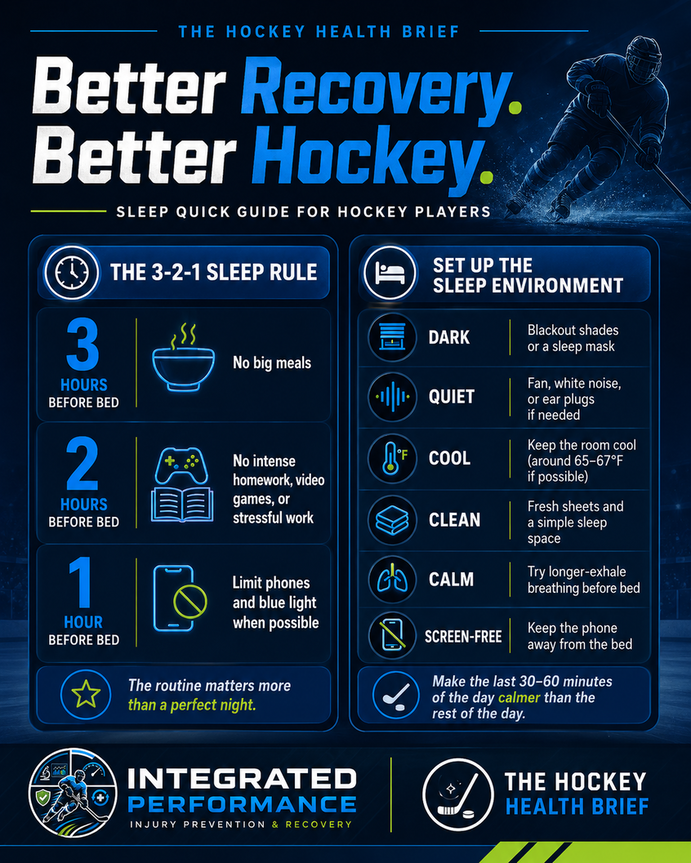
Better Recovery. Better Hockey. Sleep Quick Guide
The 3-2-1 Sleep Rule
A simple pre-bed checklist can make sleep easier.
| Time Before Bed |
What to Avoid |
Why It Helps |
| 3 hours |
No large meals |
Helps the body wind down instead of digesting a heavy meal. |
| 2 hours |
No intense homework, video games, or stressful work |
Reduces mental stimulation before bed. |
| 1 hour |
No blue light when possible |
Helps the brain transition toward sleep. |
Simple rule:
The routine matters more than chasing a perfect night.
Sleep and Performance
Decreasing injury risk not enough? It affects how they perform. Tell your son, daughter, teammate, or patient that and it may get their attention.
A 2022 systematic review and meta-analysis found that acute sleep loss led to an average 7.56% decrease in physical performance across multiple categories, including strength, speed/power, anaerobic performance, endurance, strength-endurance, and skill. [2]
A tired hockey player may still be able to skate, but decision-making, reaction time, effort, and skill execution will all be affected.
That is why summer is such a good time to build the habit. Once the season starts, schedules get more chaotic. School returns. Practices run late. Games and tournaments stack up.
If sleep is already inconsistent before the season starts, it usually does not improve once the season begins.
How to Improve Sleep This Summer
The goal is not perfection. The goal is consistency.
Here are five simple ways hockey players can improve sleep habits this summer.
1. Keep Bedtime and Wake Time Within 60 Minutes
Summer schedules get loose. That is normal.
But when bedtime and wake time swing by several hours from day to day or on weekends, the body has a harder time settling into a rhythm.
A simple goal is to keep bedtime and wake time within about 60 minutes most days.
This does not mean players can never stay up late. It means the default routine should be predictable.
Action step:
Pick a realistic summer bedtime and wake time. Try to keep both within a one-hour window for most of the week.
|
2. Build a 30-Minute Wind-Down Routine
Athletes do not need a complicated nighttime routine. They need a repeatable one.
A good wind-down routine tells the body it is time to shift out of stimulation and into recovery.
Examples:
- Warm shower
- Light stretching
- Reading
- Breathing
- Pack gear or workout clothes for the next day
- Turning lights down
- Putting the phone away
The key is to make the last 30 minutes of the day calmer than the rest of the day.
Action step:
Choose two things to do every night before bed. Keep them simple enough that they can be repeated during the season.
|
Set Up the Sleep Environment
| Sleep Habit |
Hockey Player Action |
| Dark | Use blackout shades or a sleep mask. |
| Quiet | Use a fan, white noise, or ear plugs if needed. |
| Cool | Keep the room cool, around 65–67°F if possible. |
| Clean | Use fresh sheets and keep the sleep space simple. |
| Calm | Try longer exhale breathing before bed. |
| Screen-Free | Keep the phone away from the bed. |
Hockey Health Takeaway:
Make the last 30–60 minutes of the day calmer than the rest of the day.
3. Get Screens Out of the Final 60 Minutes
Phones, video games, and late-night scrolling can push bedtime later and make it harder to wind down.
For many athletes, the issue is not just the screen itself. It is the time loss. I hear this all the time in clinic.
Me: “What time did you get to sleep last night?”
Athlete: “1 AM.”
Me: “1 AM!? What on earth were you doing?”
Athlete: “Nothin’. Scrolling TikTok.”
A player checks the phone for five minutes, then suddenly it has been 45 minutes.
That is sleep time gone.
Action step:
Set a “phone parking spot” outside the bed. Charge the phone across the room or outside the bedroom when possible. If they are on their phone within 60 minutes of bed, blue light filtering glasses may be helpful.
|
4. Use Naps Strategically
Naps can be helpful, especially after poor sleep, travel, early skates, or heavy training days.
How Hockey Players Should Nap
| Nap Type |
Length |
Best Use |
| Power Nap | 10–20 min | Quick energy and alertness boost. |
| Recovery Nap | ~30 min | Helpful after poor sleep or heavy training. |
| Full Cycle Nap | ~90 min | Best when the athlete has enough time to fully wake up. |
| NSDR | 10–20 min | Breathing, relaxation, or guided rest without needing to fall asleep. |
Simple rule:
Nap early enough that it does not steal from nighttime sleep. An easy formula is 12 hours following the middle of your sleep from the night before.
Example: If you fell asleep at 9 PM and woke up at 6 AM, the middle of that sleep window is around 1:30 AM. A good nap time is likely around 1:30 PM.
Action step:
On heavy training days, use a short nap as a recovery tool, not as a replacement for poor nighttime sleep.
|
5. Protect Sleep After Hard Training Days
The night after a hard skate, lift, camp, tournament, or multi-session day matters.
That is when the body needs recovery. If the athlete stacks hard training with poor sleep, the body may struggle to adapt.
Action step:
After the hardest training days of the week, make sleep the priority. This is not the night to stay up late just because it is summer.
|
Hydration: Drink Before You're Thirsty
Hydration is the second major recovery habit hockey players should build in the summer.
Many players spend summer days outside in the heat, then head into a cold, dry rink environment. Others go from camps to lifts to shooting sessions to outdoor activities. If they start practice already behind on fluids, they are playing catch-up before they even step on the ice.
Hydration supports energy, focus, temperature regulation, muscle function, and recovery.
The biggest mistake is waiting until a player feels thirsty at the rink.
Hydration is not something you cram before practice. It is something you build throughout the day.
Daily Hydration Framework
| Time of Day |
What Hockey Players Should Do |
Why It Matters |
| Morning | Drink a full glass or water bottle within 30 minutes of waking up. | Helps replace fluids lost overnight and starts the day hydrated. |
| Before training | Drink water with the meal or snack before skating, lifting, or outdoor activity. | Helps players arrive at the rink prepared instead of already behind. |
| During training | Take regular water breaks during practices, workouts, camps, and games. | Helps maintain energy, focus, and hydration during activity. |
| After training | Rehydrate with water and eat a meal or snack that includes sodium. | Helps replace fluids and supports recovery after sweating. |
| Evening | Continue drinking water through dinner, but avoid chugging large amounts right before bed. | Supports hydration without disrupting sleep overnight. |
For young athletes, the first goal should be to drink half your bodyweight in fl/oz of water daily. More nuanced, the American Academy of Pediatrics recommends staying well-hydrated in the days and hours before activity. For vigorous activity or heavy sweating, children ages 9–12 generally need about 3–8 ounces of water every 20 minutes, while teens may need about 34–50 ounces per hour depending on sweat rate, intensity, and conditions. [8]
These numbers do not need to become a math problem for every family. The bigger point is simple:
Do not start hydrating when you're thirsty. Start earlier.
How to Improve Hydration This Summer
Here are five simple hydration habits hockey players can build now.
1. Drink Water Early in the Day
Many athletes start the day behind. They wake up, eat quickly (maybe?), head to camp, skate, lift, or go outside, and barely drink anything until later.
That makes hydration harder than it needs to be.
Action step:
Drink water within 30 minutes of waking up.
It does not need to be perfect. Just start the day with a simple win.
|
2. Bring a Water Bottle Everywhere
The best hydration plan is the one the player can actually follow.
If the water bottle is not available, the habit usually does not happen.
Action step:
Bring a water bottle to every skate, lift, shooting session, camp, outdoor workout, and car ride.
For younger players, parents can help by making the water bottle part of the hockey bag checklist.
|
3. Start Hydrating Before the Rink
A player who starts drinking water during practice may already be behind.
The goal is to arrive prepared, not spend the whole session trying to catch up.
Action step:
Drink water with the meal or snack before training. Then sip again on the way to the rink.
|
4. Rehydrate After Training
After skating, lifting, or outdoor activity, the body needs fluid back.
Water helps, but food matters too. A post-training meal or snack that includes some high quality sodium can help replace what was lost through sweat.
This does not need to mean a sports drink after every practice. Many athletes can do well with water and a normal meal.
But after long sessions, heavy sweating, hot weather, or multiple sessions in a day, electrolytes are useful.
Action step:
After training, drink water and eat a meal or snack that includes some sodium.
Examples:
- Sandwich and fruit
- Eggs and toast
- Rice bowl
- Smoothie plus pretzels
- Greek yogurt plus granola and water
- Chocolate milk and a salty snack
|
5. Use Urine Color as a Simple Check
This is not perfect, but it is practical.
A simple guideline:
- Pale yellow usually suggests hydration is in a good place.
- Dark yellow may suggest the athlete needs more fluid.
- Completely clear all day may mean the athlete is overdoing fluids.
The goal is not to force water nonstop. The goal is steady hydration throughout the day.
Action step:
Check urine color once or twice per day, especially before training or during tournament weekends.
|
Sleep and Hydration Work Together
Sleep and hydration are separate habits, but they work together.
If an athlete drinks too much fluid late at night, they may wake up to use the bathroom and disrupt sleep. If an athlete sleeps poorly, they may feel more tired, crave more caffeine or sugar, and be less consistent with hydration. If an athlete is dehydrated, they may feel sluggish, get headaches, or struggle to focus during training.
That is why recovery should be simple and connected.
Do not overcomplicate it.
Build the habits that make the next day easier.
Parent Check-In: Signs Recovery May Be Slipping
Parents do not need to track every detail. Start by watching patterns.
| Sign |
What It May Mean |
| Waking up tired most mornings | Sleep amount or sleep quality may be too low. |
| Frequent headaches | Hydration, sleep, nutrition, or recovery may need attention. |
| More soreness than usual | Training load may be exceeding recovery. |
| Poor mood or low motivation | Fatigue may be building. |
| Nagging aches during skating | The body may not be adapting well. |
| Trouble focusing during training or games | Sleep and hydration may be affecting readiness. |
One rough night is not a crisis. One dehydrated practice is not the end of the world.
The concern is the pattern.
If the athlete is constantly tired, sore, moody, unfocused, or dealing with nagging aches, recovery habits are a good place to start.
The 7-Day Summer Recovery Challenge
For the next 7 days, pick one sleep habit and one hydration habit.
Do not try to fix everything at once. Choose one habit from each category and repeat it.
Sleep Goal: Pick One
- Keep bedtime and wake time within 60 minutes most days.
- Turn screens off 30–60 minutes before bed.
- Get morning sunlight within the first hour of waking.
- Use a short 20–30 minute nap after a hard training day if nighttime sleep was poor.
- Protect sleep the night after games, camps, tournaments, or hard lifts.
|
|
Hydration Goal: Pick One
- Drink water within 30 minutes of waking.
- Bring a water bottle to every skate, lift, camp, or workout.
- Drink water with each meal.
- Start hydrating before getting to the rink.
- Rehydrate after activity with water and a meal or snack that includes some sodium.
|
Simple rule:
Pick one sleep habit and one hydration habit. Repeat them until they become automatic.
Final Thought
Recovery does not need to be complicated.
For hockey players, the foundation starts with two simple habits: sleep enough and drink water consistently.
These habits may not feel exciting, but they support the body’s ability to train, adapt, recover, and stay healthy.
The players who build these habits in the summer are often better prepared when the season becomes busy.
Better recovery leads to better hockey.
And a healthier season starts before the season begins.
This Week’s Challenge
Pick one sleep habit and one hydration habit to improve this week.
The goal is not perfection.
The goal is building habits that carry into the hockey season.
|
References
- Dobrosielski DA, Sweeney L, Lisman PJ. The association between poor sleep and the incidence of sport and physical training-related injuries in adult athletic populations: a systematic review. Sports Medicine. 2021;51(4):777-793. doi:10.1007/s40279-020-01416-3.
- Craven J, McCartney D, Desbrow B, et al. Effects of acute sleep loss on physical performance: a systematic and meta-analytical review. Sports Medicine. 2022;52(11):2669-2690. doi:10.1007/s40279-022-01706-y.
- Fox JL, Scanlan AT, Stanton R, Sargent C. Insufficient sleep in young athletes? Causes, consequences, and potential treatments. Sports Medicine. 2020;50(3):461-470. doi:10.1007/s40279-019-01220-8.
- Gao B, Dwivedi S, Milewski MD, Cruz AI. Lack of sleep and sports injuries in adolescents: a systematic review and meta-analysis. Journal of Pediatric Orthopedics. 2019;39(5). doi:10.1097/BPO.0000000000001306.
- Walsh NP, Halson SL, Sargent C, et al. Sleep and the athlete: narrative review and 2021 expert consensus recommendations. British Journal of Sports Medicine. 2020. doi:10.1136/bjsports-2020-102025.
- Creado SA, Advani S. Sleep disorders in the athlete. Psychiatric Clinics of North America. 2021;44(3):393-403. doi:10.1016/j.psc.2021.04.010.
- Montero A, Stevens D, Adams R, Drummond M. Sleep and mental health issues in current and former athletes: a mini review. Frontiers in Psychology. 2022;13:868614. doi:10.3389/fpsyg.2022.868614.
- American Academy of Pediatrics. Choose Water for Healthy Hydration. HealthyChildren.org. Updated July 26, 2024.
- National Sleep Foundation. The Family That Sleeps Well, Does Well. Available at: thensf.org.
|
 The Hockey Health Brief · Newsletter #2 · Current Issue