|
In summer, hockey opportunities are endless.
But busy does not always mean better.
A full calendar does not automatically mean better development. More skates, more lifts, more shooting, more camps, and more tournaments only help if the player is actually adapting.
That is the key.
On paper, summer sounds like the “offseason.”
In reality, a lot of hockey players are skating, lifting, shooting, doing skills, training with private coaches, jumping into camps, and adding tournaments.
Sometimes more than in the season.
The problem is not that players are training.
Training is good. Especially for the developing athlete.
The problem is when everything stacks together and nobody is looking at the total picture.
One skate usually is not the issue.
One lift usually is not the issue.
One shooting session usually is not the issue.
The issue is when a player has a skills skate Monday, lower body lift Tuesday, small-area games Wednesday, camp Thursday and Friday, tournament games on the weekend, poor sleep, not enough food, and hydration that starts when they walk into the rink.
That is not development.
That is survival.
And if it continues long enough, the body usually finds a way to get your attention.
That might show up as heavy legs, slower skating, nagging hip or groin pain, getting sick more often, or a player who simply looks cooked before the season even starts.
This newsletter is not about telling hockey players to do less.
It is about helping them train hard enough to improve and recover well enough to adapt.
That is the sweet spot.
Why This Builds on the Last Two Issues
In the first Hockey Health Brief, we talked about hip and groin health in hockey players.
In the last issue, we talked about recovery, specifically sleep and hydration.
This issue connects both of those ideas.
Hip and groin issues usually do not show up out of nowhere. And recovery does not matter much if the total training load is so high that the athlete can never catch up.
If sleep and hydration are the foundation, training load is the stress we are asking the foundation to support.
When the stress is appropriate, players adapt.
When the stress is too much for too long, performance and health can start to slide.
Part 1: Count the Total Load
The Target: 8–10 Athletic Exposures Per Week
For many hockey players in the summer, I like the idea of aiming for roughly 8–10 athletic exposures per week.
That is not a perfect number.
It is a starting point.
An athletic exposure is any planned training session that creates physical or mental stress on the athlete.
For hockey players, that may include:
- On-ice skills session
- Team skate
- Small-area games
- Shooting session
- Strength training
- Speed or power session
- Conditioning session
- Tournament game
- Camp day
- Mobility or recovery session if it is structured
Not all exposures are equal.
A 30-minute shooting session is not the same as a tournament game. A recovery lift is not the same as a heavy lower body day. A skill acquisition skate is not the same as a conditioning skate.
But they all count.
That is the first mistake many players make.
They only count the skates.
The body counts everything.
|
Hockey Health Takeaway:
For a serious summer hockey week, aim for 8–10 total athletic exposures, but only 3–4 of those should feel truly high intensity.
|
The Exposure Budget
Think of the week like a budget.
You only have so many high-quality training opportunities before fatigue starts to reduce the return on investment.
A good summer week may include:
| Exposure Type |
Weekly Target |
| On-ice skill acquisition |
2–3 |
| Small-area / game-like hockey |
1–2 |
| Strength training |
2–3 |
| Speed, power, or conditioning |
1–2 |
| Recovery / mobility |
1 |
| Total |
8–10 exposures |
This gives the athlete enough hockey exposure to improve, enough off-ice work to build physical capacity, and enough recovery to actually absorb the work.
The point is not to make every player follow the same schedule.
The point is to stop stacking random work on top of random work and calling it development.
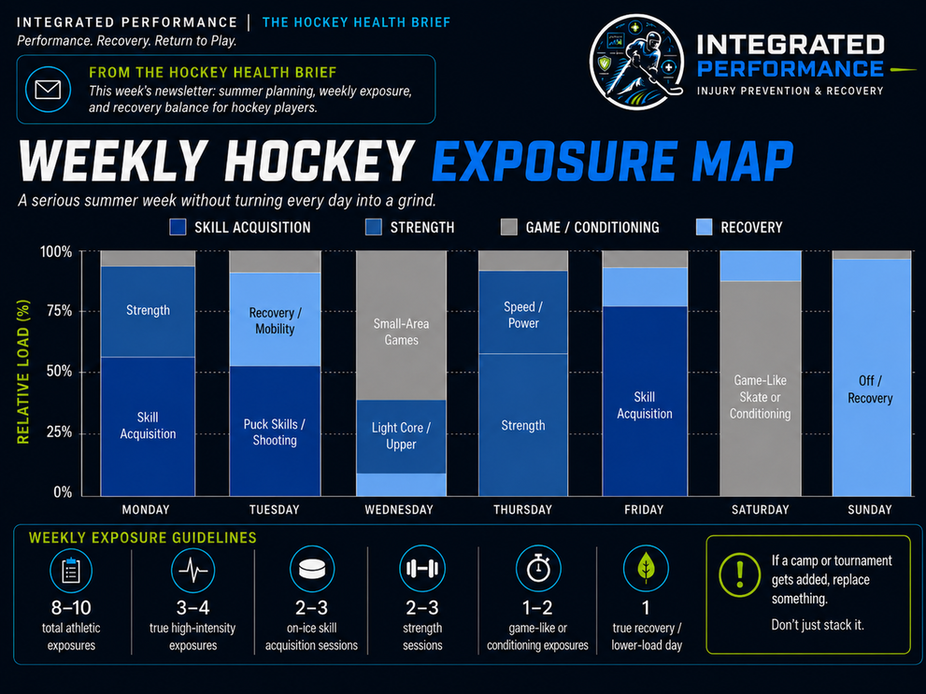
Weekly Hockey Exposure Map
Sample Summer Hockey Week
Here is an example of a balanced week based on hockey alone.
This assumes the player is healthy, sleeping well, eating enough, and not currently dealing with a nagging injury.
| Day |
Exposure |
Focus |
Intensity |
| Monday |
On-ice skill acquisition + strength training |
Learn + build strength |
Moderate |
| Tuesday |
Shooting / puck skills + recovery mobility |
Low-load skill + recovery |
Low / Moderate |
| Wednesday |
Small-area games + light core / upper body |
Transfer + compete |
High |
| Thursday |
Strength training + speed / power |
Build physical capacity |
Moderate / High |
| Friday |
On-ice skill acquisition |
Quality skill before fatigue |
Moderate |
| Saturday |
Conditioning or game-like skate |
Fitness + repeat effort |
High |
| Sunday |
Off or recovery |
Absorb the week |
Low |
That gives the player 8–9 exposures.
If the player also has a camp, tournament, or extra team skate, something else should probably come out.
Not because the player is soft.
Because adaptation requires room.
What If There Is a Tournament?
Tournament weekends change the whole week.
A tournament is not just “a few games.”
It is repeated high-intensity hockey, travel, warm-ups, emotional stress, poor food options, disrupted sleep, and a lot of time at the rink.
So if there is a tournament on the weekend, the week should look different.
Tournament Week Example
| Day |
Exposure |
Focus |
Intensity |
| Monday |
Recovery / mobility |
Reset from previous week |
Low |
| Tuesday |
On-ice skill acquisition + strength training |
Clean touches, timing, confidence |
Moderate |
| Wednesday |
Shooting / puck skills |
Light technical work |
Low |
| Thursday |
Short practice or pre-tournament skate |
Rhythm, pace, confidence |
Moderate |
| Friday |
Game 1 |
Competition |
High |
| Saturday |
Games 2–3 |
Competition |
High |
| Sunday |
Game 4 or recovery |
Competition / recovery |
High or Low |
That is already 8–10 exposures.
Do not add a hard conditioning session and a heavy lower body lift just because the player “has time.”
The tournament is the hard work.
The goal that week is to arrive fresh enough to compete and leave healthy enough to keep training.
Part 2: Build the Month, Not Just the Week
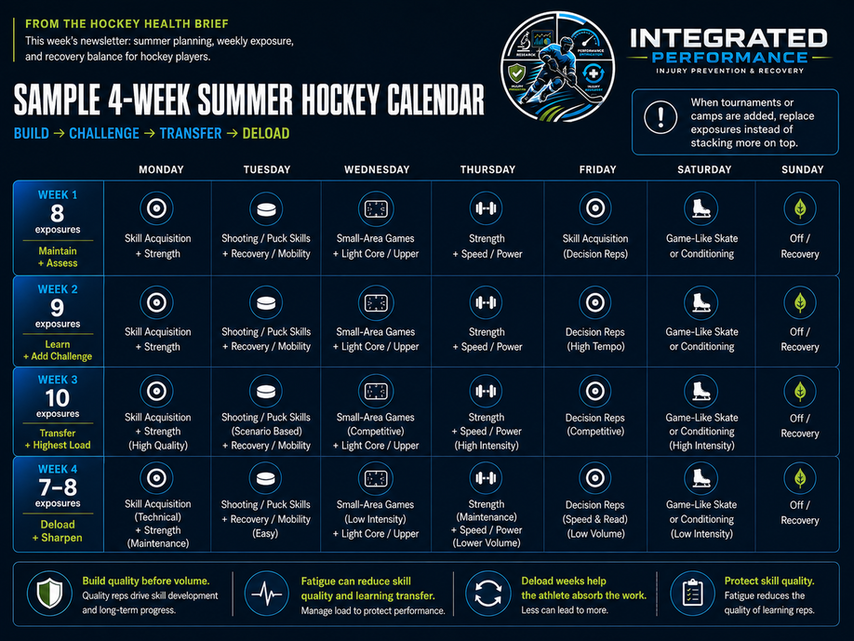
Sample 4-Week Summer Hockey Calendar
Sample 4-Week Summer Hockey Block
Here is a simple month-long structure.
The goal is to build, not just pile on.
| Week |
Total Exposures |
Focus |
Notes |
| Week 1 |
8 exposures |
Maintain + assess |
Establish rhythm, get quality reps, avoid jumping too fast. |
| Week 2 |
9 exposures |
Learn + add challenge |
Increase challenge slightly. Add more variable skill work. |
| Week 3 |
10 exposures |
Transfer + highest load |
Most game-like week. Add pressure, decision-making, and conditioning. |
| Week 4 |
7–8 exposures |
Deload + sharpen |
Reduce volume, keep speed and skill quality, let the body catch up. |
That fourth week matters.
A lower-load week is not wasted time.
It is where the athlete absorbs the previous three weeks.
This is one of the biggest mistakes in summer training. Players stack hard week after hard week after hard week, then wonder why they feel flat, sore, or unmotivated.
The body needs weeks where the goal is not to add more.
Sometimes the goal is to adapt to what has already been done.
|
Hockey Health Takeaway:
The deload week is not where development stops. It is where the previous work has a chance to stick.
|
Part 3: Train Hard, But Dose It Better
Training Stress Is Not Bad
Let’s be clear.
Training stress is not the enemy.
Hockey players need stress to improve. They need to skate fast, lift heavy, shoot pucks, compete, sprint, change direction, battle, and get uncomfortable.
The body adapts when it is challenged.
But the body adapts best when the challenge is paired with enough recovery.
That means the goal is not to remove stress.
The goal is to dose it better.
Think of training like a prescription.
The right dose can make the player stronger, faster, more resilient, and more confident.
Too little may not move the needle.
Too much, too often, with not enough recovery, can create a problem.
The International Olympic Committee consensus statement on load in sport makes this same point: load is not automatically bad. It is a normal and necessary part of athletic development. The problem is when training and competition load are poorly managed, increased too quickly, or not balanced with the athlete’s ability to recover. [1]
|
Hockey Health Takeaway:
The goal is not to avoid hard work. The goal is to make sure the athlete can adapt to the hard work.
|
Part 4: Skill Acquisition Is Not Just Practice
Practice Is Not the Same as Skill Acquisition
This is an important point.
More practice does not automatically mean more skill.
Skill acquisition is not just doing more reps. It is the process of learning, adapting, problem-solving, and being able to use a skill when the environment changes.
That matters in hockey because the game is not clean.
There is pressure, contact, fatigue, defenders, decisions, speed, and chaos.
A player can look great in a controlled drill and still struggle to use that skill in a game.
That does not mean the drill was useless.
It means we have to understand the difference between performance in practice and learning that transfers.
A skill session where the player gets 100 clean reps can be useful.
But if every rep looks the same, the challenge is too low, the player never has to make a decision, and the skill does not transfer to game speed, we should be careful calling that “development.”
Skill acquisition research continues to emphasize that practice quality matters more than just accumulating hours. The SAFE framework highlights the importance of appropriate challenge, representative practice, individualized feedback, and assessing whether learning actually sticks beyond the session. [8]
In other words:
A player looking better during a drill today does not always mean the player learned something that will show up in a game tomorrow.
That is why offseason skill work should not only ask:
“How many reps did we get?”
It should also ask:
- Did the player solve a problem?
- Did the skill transfer to a more game-like situation?
- Can they do it when tired?
- Can they do it with pressure?
- Can they do it next week?
- Can they choose when to use it?
That is skill acquisition.
Not just practice.
|
Hockey Health Takeaway:
Good skill work is not just more reps. Good skill work creates learning that transfers.
|
Skill Acquisition vs. Conditioning
This is where summer hockey gets messy.
A lot of skill sessions accidentally turn into conditioning sessions.
The athlete gets tired, the reps get sloppy, skating mechanics break down, the puck starts bouncing, decision-making slows, and the coach or player keeps pushing because “more reps are better.”
But fatigue reduces quality.
And if the goal of the session is skill acquisition, quality matters.
There is a time to train through fatigue.
There is a time to build conditioning.
There is a time to practice executing skills while tired.
But that needs to be intentional.
Do not accidentally turn every skill session into a conditioning test.
Skill Acquisition Session
The goal is learning.
You want enough challenge to force adaptation, but not so much fatigue that the player cannot execute, explore, or make decisions.
A good skill acquisition session might include:
- Edge work with variable exits
- Shooting from different foot positions
- Puck handling with changing speed
- Passing with movement and timing
- Decision-based 1v1 or 2v1 reads
- Small-area constraints
- Pressure that increases gradually
- Rest periods that allow quality reps
The player should be challenged, but not cooked.
Mistakes are okay.
Sloppy fatigue reps are different.
Conditioning Session
The goal is physical stress.
You are training the athlete to tolerate repeated effort, recover between bursts, and maintain output.
A conditioning session might include:
- Repeated sprint intervals
- Tempo skating
- Small-area games with short rest
- Battle drills
- Shift-length repeat efforts
- Bike intervals
- Sled pushes
- Shuttle work
The player should be tired.
That is the point.
But do not confuse that with a skill session.
The Difference
| Session Type |
Main Goal |
What Quality Looks Like |
| Skill Acquisition |
Learning and transfer |
Player solves problems, makes decisions, and executes with control. |
| Conditioning |
Physical capacity |
Player sustains effort, repeats output, and tolerates fatigue. |
| Game-Like Transfer |
Skill under pressure |
Player applies skill with speed, contact, fatigue, and decision-making. |
All three matter.
But they are not the same.
|
Hockey Health Takeaway:
If the goal is skill acquisition, do not let fatigue steal the quality of the reps.
|
The Better Skill Session Formula
A good summer skill session should have a purpose.
Try this structure:
1. Clean Reps
Start with a technical focus.
Example:
- Shooting mechanics
- Edge quality
- Puck position
- Passing touch
- First touch
- Deception
Keep fatigue low.
The goal is feel and quality.
2. Variable Reps
Now change the environment.
Example:
- Different starting positions
- Different speeds
- Different angles
- Different puck positions
- Different timing
- Different finishes
The goal is adaptability.
3. Decision Reps
Now make the player read something.
Example:
- Coach gives a visual cue
- Defender pressures from different angles
- Player chooses pass or shot
- Player reacts to space
- Small-area game constraint
- 1v1 or 2v1 read
The goal is transfer.
4. Stop Before Quality Falls Apart
This is the hard part.
End or change the drill when quality drops.
Fatigue is not always the badge of a good session.
Sometimes it is the reason the session stops working.
|
Hockey Health Takeaway:
Skill sessions should end when learning quality drops, not when the player is completely exhausted.
|
The Summer Skill Trap
The offseason can fool people.
A player may be on the ice all summer and still not be developing the way we think.
If the work is too repetitive, too controlled, too easy, or too disconnected from the game, the player may be getting better at the drill more than getting better at hockey.
That does not mean we throw out technical work.
Technical work matters.
But technical work should eventually lead somewhere.
The offseason is a great time to clean up mechanics, build confidence, and work on weaknesses. But as the summer progresses, players also need opportunities to apply skills in situations that look and feel more like the game.
That might mean changing speed, changing direction, adding decision-making, adding pressure, adding defenders, adding small-area games, mixing skills together, varying the starting position, varying the finish, and asking the player to read, react, and solve.
Research on contextual interference and practice design supports the idea that more variable or interleaved practice can improve retention and transfer, although the benefits may depend on the athlete, age, task, and setting. [9,10]
Translation?
Random, game-like, and variable practice can be powerful, but it has to be dosed well.
You do not need every session to be chaos.
But if every session is clean, predictable, and comfortable, the player may not be learning how to use the skill when hockey gets messy.
Part 5: Know When to Adjust
Signs a Player May Be Doing Too Much
Parents, coaches, and athletes do not need to monitor every metric.
But they should pay attention to patterns.
Here are common signs that training load may be exceeding recovery:
| Sign |
What It May Mean |
| Persistent soreness |
The body is not recovering between sessions. |
| Heavy legs |
Fatigue may be accumulating. |
| Slower skating |
The athlete may be under-recovered. |
| Nagging groin, hip, back, knee, or ankle pain |
Tissue tolerance may not be keeping up with load. |
| Poor sleep |
The nervous system may be staying too stimulated. |
| Low motivation |
Mental or physical fatigue may be building. |
| Irritability |
Recovery may be slipping. |
| Getting sick more often |
The body may be run down. |
| Performance dropping despite training more |
The athlete may need recovery, not more work. |
| Skill quality falling off early |
Fatigue may be stealing the purpose of the session. |
One bad day is not a crisis.
Everyone gets sore. Everyone has tired legs. Everyone has an off skate.
The concern is when these signs become the pattern.
That is when it is time to adjust.
The Hip and Groin Connection
Hockey places a lot of demand on the hips, groin, trunk, and pelvis.
Every stride requires the athlete to push, recover, rotate, stabilize, and repeat.
Now layer on the summer schedule: more skates, more edge work, more shooting, more lifting, more sprinting, more tournaments, and more camps.
That is a lot of repeated stress on the hips, groin, trunk, and pelvis.
The hips and groin can handle a lot.
But they need enough capacity and enough recovery to tolerate the load.
A groin issue often does not start with one dramatic moment. Sometimes it starts as a small ache that shows up after skating. Then it warms up and feels okay. Then it comes back sooner. Then it lingers longer. Then it changes how the athlete skates.
That is the window where we want to catch it.
Not when the player can barely stride.
Hip and groin research continues to highlight the importance of strength, coordination, and appropriate load management around the hip, groin, and pelvis. For hockey players, that means we cannot only think about one exercise or one stretch. We need to consider the total demand placed on the athlete. [3]
|
Hockey Health Takeaway:
Do not ignore the early warning signs. A small groin or hip issue in July can become a bigger problem in September if the load keeps climbing and recovery stays poor.
|
The Recovery Connection
Sleep and hydration are not magic.
But they help determine whether the athlete can adapt to the work.
A player who sleeps well, hydrates consistently, eats enough, and has recovery days will usually tolerate training better than a player who is under-slept, under-fueled, dehydrated, and booked every day.
Same training plan.
Different response.
That is why recovery matters.
The question is not just:
“How much is the player doing?”
It is also:
“How well is the player recovering from what they are doing?”
Because a training plan that works for one athlete may be too much for another.
Age, training history, strength, sleep, nutrition, stress, growth spurts, and injury history all matter.
Context matters.
The Green-Yellow-Red System
Here is a simple way to think about summer training load.
Green Light
The player is training hard and adapting well.
Signs:
- Normal soreness that improves
- Good energy
- Good mood
- Skating quality is stable or improving
- Skill quality stays high
- No nagging pain
- Sleeping well
- Motivated to train
What to do:
Keep going. The plan is probably in a good place.
Yellow Light
The player is showing signs that recovery may be slipping.
Signs:
- Soreness lasting longer than usual
- Heavy legs for multiple sessions
- Skill quality drops early
- Nagging tightness or discomfort
- Lower motivation
- Poor sleep
- Skating looks a little off
- More irritability than normal
What to do:
Adjust before it becomes a bigger issue.
This might mean reducing intensity, skipping extra work, changing a lift, adding a recovery day, or protecting sleep for a few nights.
Yellow light does not mean panic.
It means pay attention.
Red Light
The player is not tolerating the current load.
Signs:
- Sharp pain
- Limping
- Pain that changes skating mechanics
- Pain that worsens each session
- Swelling
- Loss of strength
- Persistent fatigue
- Performance dropping hard
- The athlete looks run down and cannot bounce back
What to do:
Stop guessing. Reduce load and get help if symptoms are not improving.
This is where pushing through often creates a longer road back.
Part 6: The Weekly Reset
A 5-Minute Check-In
Once per week, preferably Sunday, take five minutes and look at the week ahead.
Ask these questions:
- How many total athletic exposures does the player have this week?
- Is the week between 8–10 exposures?
- How many are high intensity?
- Are there more than 2–3 hard days in a row?
- Are skill sessions protected from excessive fatigue?
- Is there a tournament, camp, or travel?
- Where are the heavy lower body lifts?
- Is the athlete sleeping enough?
- Is anything starting to hurt?
- What needs to be adjusted?
This is about being intentional.
If the week already has a camp, three skates, and a tournament, maybe that is not the week to add extra conditioning and a heavy lower body lift.
If the athlete is sleeping poorly and dragging, maybe the best training decision is to protect recovery for a few days.
If the athlete feels great, is sleeping well, and is adapting, maybe the plan is right on track.
The weekly reset helps families stop reacting after problems show up.
The 7-Day Training Load Challenge
For the next week, do a simple training load audit.
Step 1: Write Down Every Exposure
Include:
- On-ice skill sessions
- Team skates
- Small-area games
- Strength training
- Speed work
- Conditioning
- Shooting sessions
- Camps
- Tournaments
- Recovery sessions
Step 2: Count the Total
Aim for 8–10 athletic exposures in the week.
If the number is 12, 13, or 14, something probably needs to come out.
Step 3: Circle the Hard Days
A hard day is anything that feels physically or mentally demanding.
Step 4: Protect Skill Quality
Ask:
- Are skill sessions happening when the player is fresh enough to learn?
- Are we turning every skate into conditioning?
- Is fatigue reducing the quality of the reps?
- Is the player getting better at hockey or just getting tired?
Step 5: Make One Adjustment
Do not overhaul everything.
Make one smart adjustment.
Examples:
- Move a heavy lift
- Remove a conditioning session
- Shorten a shooting session
- Add a recovery day
- Protect sleep after a hard skate
- Replace a low-quality skate with recovery
- Address a nagging ache before it becomes a bigger issue
|
Simple rule:
Train hard. Learn with quality. Recover enough to adapt.
|
Key Takeaways
Busy does not mean better.
Aim for 8–10 athletic exposures per week.
Only 3–4 exposures should feel truly high intensity.
Skill acquisition is not just more practice. It is learning that transfers.
If the goal is skill acquisition, do not let fatigue steal the quality of the reps.
Do not judge summer training by how full the calendar looks. Judge it by how well the player is adapting.
If the player only gets better at the drill, we have to ask whether the drill is doing its job.
Train hard. Learn with quality. Recover enough to adapt.
Final Thought
The best hockey players are not always the ones who do the most.
They are usually the ones who stack quality work over time.
They train hard, recover well, adapt, stay available, and keep stacking quality work.
That is what we want.
Summer is a great time to improve, but the goal is not to win the offseason by being the busiest player on the calendar.
The goal is to enter the season healthy, prepared, and ready to play.
Busy does not mean better.
Better is better.
This Week’s Challenge
Look at your player’s full training calendar.
Do not just count skates.
Count every exposure.
Then ask three questions:
Are we in the 8–10 exposure range?
Are skill sessions protected from fatigue?
Is this helping the player adapt, or just adding more work?
Small adjustments now can make a big difference when the season starts.
References
- Soligard T, Schwellnus M, Alonso JM, et al. How much is too much? Part 1: International Olympic Committee consensus statement on load in sport and risk of injury. British Journal of Sports Medicine. 2016;50(17):1030-1041. doi:10.1136/bjsports-2016-096581.
- Brenner JS; Council on Sports Medicine and Fitness. Sports specialization and intensive training in young athletes. Pediatrics. 2016;138(3). doi:10.1542/peds.2016-2148.
- Thorborg K, Hölmich P, Mosler AB, et al. Current clinical concepts: exercise and load management of adductor strains, adductor ruptures, and long-standing adductor-related groin pain. Journal of Athletic Training. 2023;58(7-8):589-600. doi:10.4085/1062-6050-0154.22.
- Schwellnus M, Soligard T, Alonso JM, et al. How much is too much? Part 2: International Olympic Committee consensus statement on load in sport and risk of illness. British Journal of Sports Medicine. 2016;50(17):1043-1052. doi:10.1136/bjsports-2016-096572.
- Bergeron MF, Mountjoy M, Armstrong N, et al. International Olympic Committee consensus statement on youth athletic development. British Journal of Sports Medicine. 2015;49(13):843-851. doi:10.1136/bjsports-2015-094962.
- Post EG, Trigsted SM, Riekena JW, et al. The association of sport specialization and training volume with injury history in youth athletes. American Journal of Sports Medicine. 2017;45(6):1405-1412. doi:10.1177/0363546517690848.
- Short S, Delahunt E, Thorborg K, et al. Hip and groin injury prevention in elite athletes and team sport: current challenges and opportunities. International Journal of Sports Physical Therapy. 2021;16(1):270-281. doi:10.26603/001c.18705.
- Williams AM, Hodges NJ. Effective practice and instruction: a skill acquisition framework for excellence. Journal of Sports Sciences. 2023;41(9):833-849. doi:10.1080/02640414.2023.2240630.
- Czyż SH, Wójcik AM, Solarská P, Kiper P. High contextual interference improves retention in motor learning: systematic review and meta-analysis. Scientific Reports. 2024;14(1):15974. doi:10.1038/s41598-024-65753-3.
- Czyż SH, Wójcik AM, Solarská P. The effect of contextual interference on transfer in motor learning: a systematic review and meta-analysis. Frontiers in Psychology. 2024;15:1377122. doi:10.3389/fpsyg.2024.1377122.
- Hodges NJ, Lohse KR. An extended challenge-based framework for practice design in sports coaching. Journal of Sports Sciences. 2022;40(7):754-768. doi:10.1080/02640414.2021.2015917.
- Güllich A, Macnamara BN, Hambrick DZ. What makes a champion? Early multidisciplinary practice, not early specialization, predicts world-class performance. Perspectives on Psychological Science. 2022;17(1):6-29. doi:10.1177/1745691620974772.
|