Clinical Guidelines
Clinical practice guidelines for sports rehabilitation.
A growing resource library organized by athlete status: performance conditioning for healthy athletes, Return to Game Readiness for late-stage decisions, and injury rehabilitation guidelines organized by joint.
Built for clinical decision-making.
Organized by athlete status. Written with criteria, timelines, loading progressions, and sport-specific return-to-play considerations in mind.
Guideline Library
Organized by athlete status
Start with the decision in front of you: healthy performance preparation, late-stage Return to Game decision-making, or diagnosis-specific injury rehabilitation.
Resource Pathways
Choose the pathway that matches the athlete's status.
This keeps healthy performance preparation separate from late-stage Return to Game decisions and diagnosis-specific injury rehabilitation.
01
Performance & Conditioning
For healthy, medically cleared players preparing for training camp or the start of the season.
Open 12-Skate Framework → 02Return to Game
For medically cleared athletes participating in full practice while still building toward game readiness.
Open Readiness Toolkit → 03Injury Rehabilitation
Diagnosis-specific guidelines organized by Shoulder, Hip & Groin, Knee, and Ankle.
Browse Injury Guidelines →
Performance & Conditioning
12-Skate Hockey Conditioning Framework
A four-stage, 12-skate progression for healthy, medically cleared junior, college, and professional players preparing for camp or the start of the season.
Designed for: full ice, timing or coach control, scored competition in every session, and a 60-minute session ceiling.
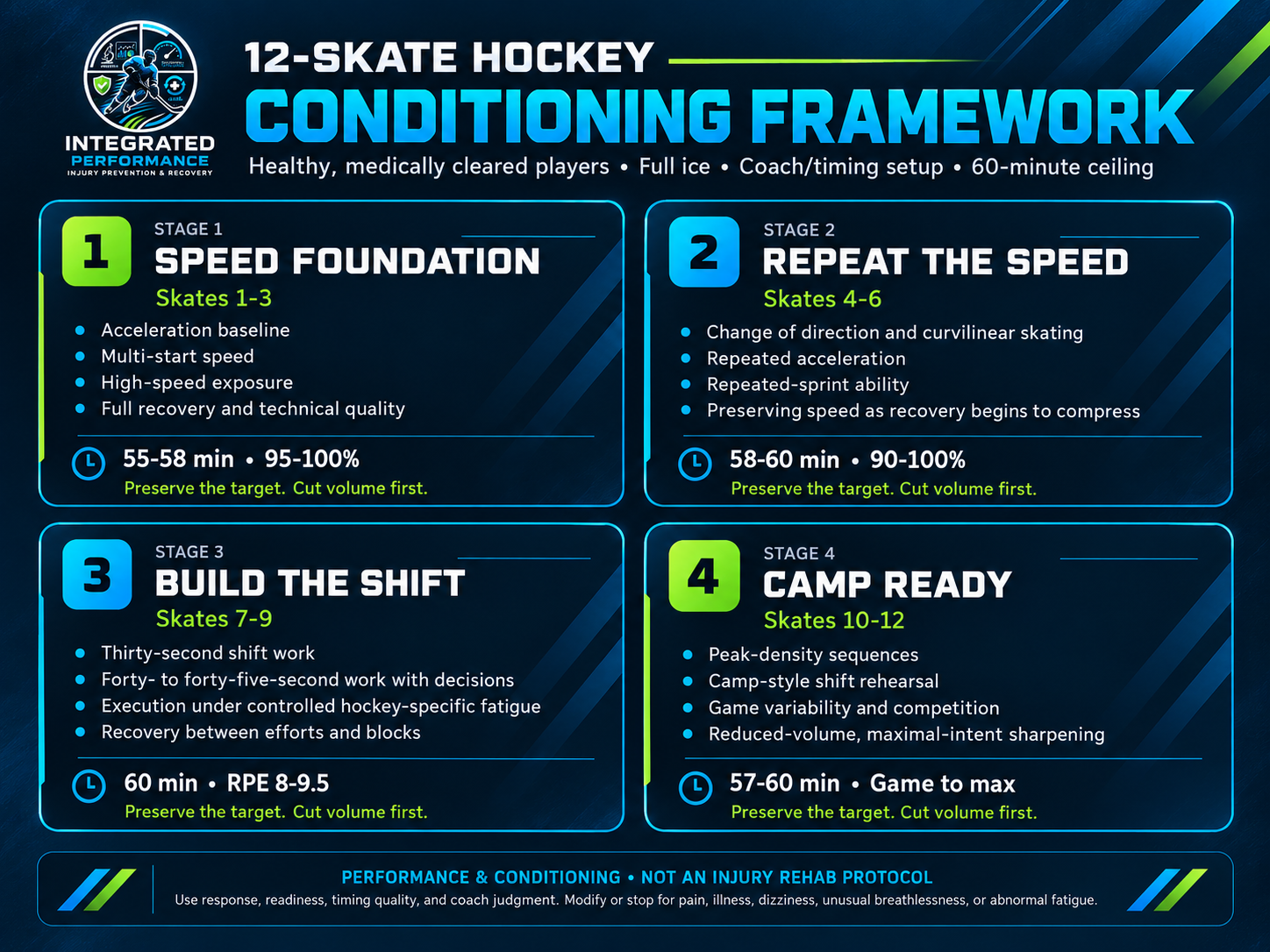
Stage 1Speed FoundationSkates 1-3
Stage 2Repeat the SpeedSkates 4-6
Stage 3Build the ShiftSkates 7-9
Stage 4Camp ReadySkates 10-12
Scope note: This is a performance resource, not an injury-rehabilitation protocol. It should be used with healthy, medically cleared athletes and adjusted based on readiness, response, and team policy.
Featured Toolkit
Return to Game Readiness
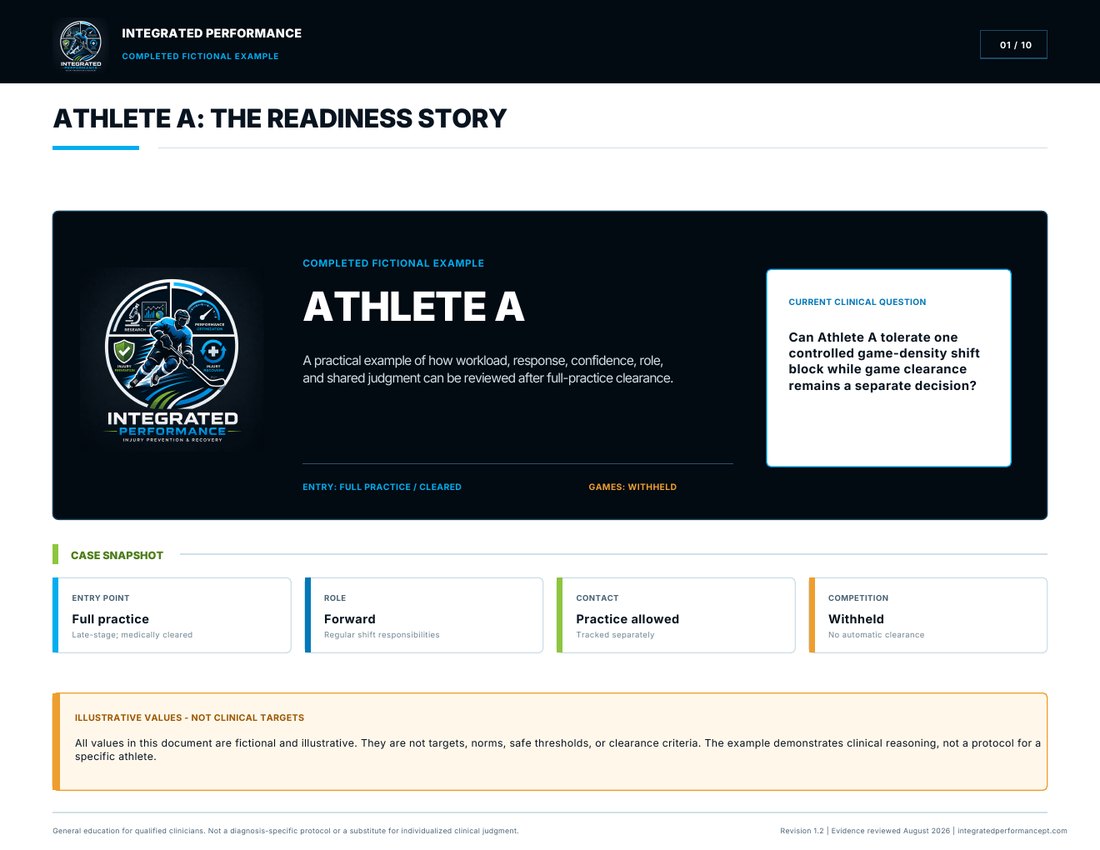
A fillable clinician toolkit and completed fictional example for reviewing workload, response, confidence, role, contact, and shared progression after full-practice clearance.
Clinical use note: Use after the athlete is medically cleared for full practice while game clearance remains a separate decision.
Downloadable PDFs
Two resources built to work together.
The fillable toolkit gives clinicians the structure. The completed fictional example shows how the reasoning looks in practice.
Live Toolkit Calculator
Return to Game Readiness Calculator
This calculator mirrors the worksheet logic from the Return to Game Readiness clinician toolkit. It calculates session dose, optional Edwards-style TRIMP, TRIMP per minute, weekly totals, and recent-to-prior context. It does not create medical, contact, or game clearance.
Source-of-truth rules used here:
sRPE load = ice minutes x session RPE.
Zone-weighted TRIMP uses the Edwards-style five-zone example from the toolkit.
Recent:prior uses current 7-day TRIMP divided by the mean of the previous four completed weeks, only when the same method was used.
01
Session exposure
Enter the current hockey exposure. Required dose fields come first. Add HR fields only when the capture and method are reliable.
HR
Optional HR-informed pathway
Use this only when the HR device, HRmax, zones, platform, and TRIMP method are consistent.
The toolkit's Edwards-style example uses weights 0, 1, 2, 3, 4, and 5. The 80-89% zone crosses the 85% threshold, so minutes above 85% should come from the monitor export, not from this broad zone split.
02
12-week TRIMP trend
Enter weekly totals. The recent-to-prior calculation stays blank until four prior completed weeks use the same TRIMP method.
| Week | Sessions | Ice min | sRPE AU | TRIMP AU | Min >85% | Data status | Clinical response / hockey context |
|---|
03
Shared progression decision
Complete after reviewing current exposure, personal reference, recovery, confidence, contact, and hockey context.
Stop and assess flags
Select any finding that should stop automatic progression and prompt clinical reassessment.
Clinical boundary:
Use this after medical clearance for full practice while unrestricted competition remains pending. Contact clearance, game clearance, and return to performance remain separate. Agreement never overrides a contraindication, restriction, or individualized clinical judgment.
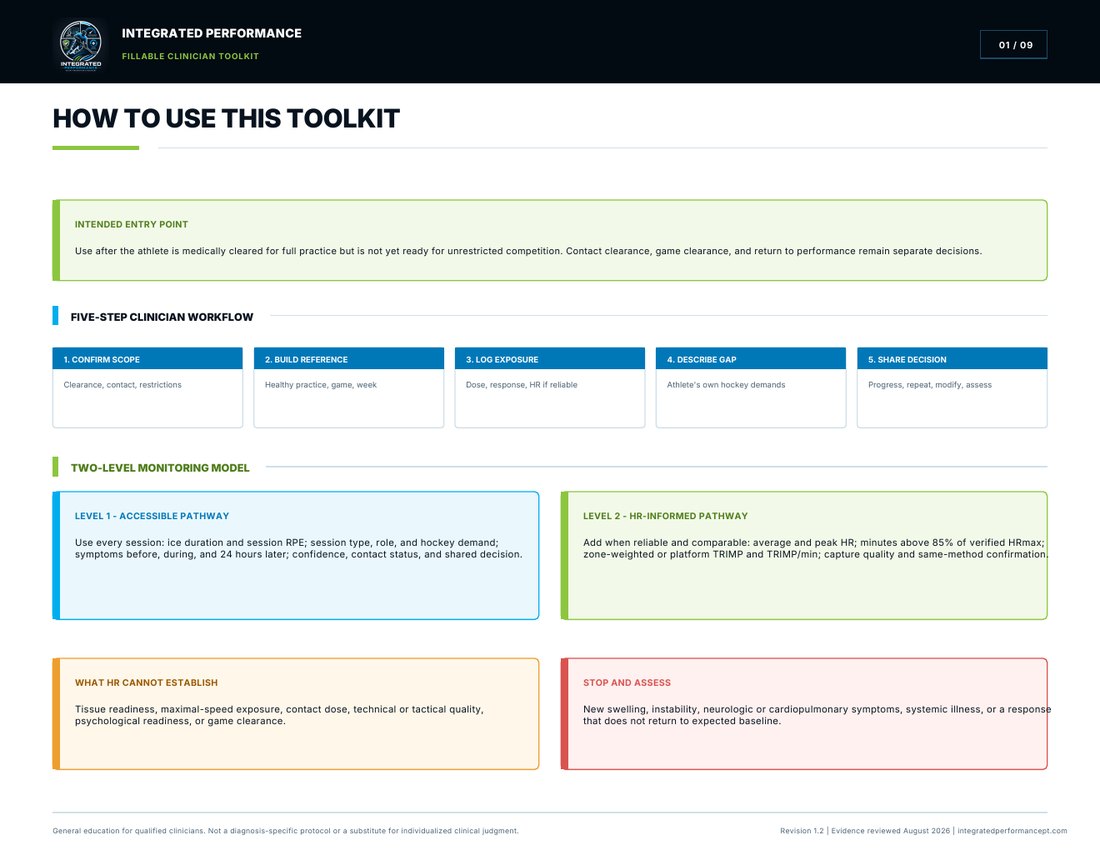
Clinician Workflow
Late-stage guidance for the gap between practice clearance and game clearance.
This workflow keeps contact clearance, game clearance, and return to performance separate while the athlete builds and demonstrates readiness.
01Confirm scope
Clearance, contact, restrictions
02Build reference
Healthy practice, game, week
03Log exposure
Dose, response, HR if reliable
04Describe gap
Athlete's own hockey demands
05Share decision
Progress, repeat, modify, assess
Monitoring Model
Accessible first. HR-informed when reliable.
Heart-rate data can add context, but it does not establish tissue readiness, maximal-speed exposure, contact dose, technical quality, psychological readiness, or game clearance.
Accessible pathway
Use every session: ice duration, session RPE, exposure type, role, hockey demand, symptoms before/during/24 hours later, confidence, contact status, and shared decision.
HR-informed pathway
Add average and peak HR, minutes above 85% of verified HRmax, platform TRIMP or zone-weighted TRIMP, TRIMP/min, capture quality, and same-method confirmation.
Use numbers as context
Recent-to-prior calculations summarize training history. Do not use them as injury predictors, safe-zone rules, progression targets, or clearance thresholds.
Response still governs
Stop and reassess for new swelling, instability, neurologic or cardiopulmonary symptoms, systemic illness, or a response that does not return to expected baseline.
Clinical use note:
These resources are general education for qualified clinicians. They are not a diagnosis-specific protocol and are not a substitute for individualized clinical judgment, medical clearance, team policy, or shared decision-making.
Shoulder
Shoulder Guidelines
PDF Guideline
ACJ Separation
Hockey-specific return-to-play progression from acute protection through full contact, with timelines, criteria, testing, and return-to-sport checkpoints.
Open PDF → PDF GuidelineArthroscopic Bankart Repair
Return-to-ice and contact progression after arthroscopic Bankart repair, including protected motion, skating exposure, contact preparation, and clearance criteria.
Open PDF →
Hip
Hip Guidelines
PDF Guideline
Hip Arthroscopy
Hockey-specific return-to-hockey progression after hip arthroscopy, including early protection, return-to-skate preparation, skating exposure, contact progression, and RTP criteria.
Open PDF → PDF GuidelineAdductor Strain
Grade-based conservative management and return-to-play progression for hockey athletes, including Grade 1, Grade 2, Grade 3, skating progression, and Copenhagen loading guidance.
Open PDF →
Knee
Knee Guidelines
PDF Guideline
ACL Reconstruction
Hockey-specific return-to-ice and play progression after ACL reconstruction, including first-skate criteria, exposure dosing, practice progression, contact preparation, and RTP testing.
Open PDF → PDF GuidelineMCL Reconstruction
Hockey-specific return-to-ice and contact progression after MCL reconstruction, including medial stability, valgus-control development, first-skate criteria, and contact clearance.
Open PDF →
Ankle
Ankle Guidelines
PDF Guideline
Achilles Repair
Hockey-specific return-to-ice progression after Achilles tendon repair, including protected loading, strength development, running, skating, practice, and competition phases.
Open PDF → PDF GuidelineSyndesmosis Repair
Criteria-based return-to-ice roadmap after syndesmosis repair, including controlled weight bearing, skating progression, edge work, practice integration, and RTP criteria.
Open PDF →