|
Welcome back to the Hockey Health Brief.
As summer starts to shift into training camp, school, and the start of a new season, a lot changes at once.
Players are leaving for college. Younger athletes are heading back into school-year routines. Junior players are moving into new environments. Camp schedules pick up. Team skates become more regular. Sleep changes. Travel changes. Stress changes. Life changes.
That is exactly why this felt like a good week to zoom out.
Over the first 11 Hockey Health Briefs, we have covered a lot: hip and groin health, recovery, long-term development, return to play, skating speed, training camp preparation, testing, recovery tools, and injury prevention.
This week is about bringing it all together.
Not every detail. Not every study. Not every checklist.
Just the principles that matter most as athletes head into a new season, a new routine, or a new place.
|
Newsletter #12
The Hockey Health Brief Season Guide
|
What to Take With You From the First 11 Newsletters
The details will change.
The rink changes. The team changes. The coach changes. The class schedule changes. The city changes. Sometimes even the role changes.
But the principles do not.
|
That is the key idea for this week.
|
A player does not need a brand-new philosophy every time life gets busy. They need a small number of good principles they can keep coming back to.
|
New place. New routine. Same standards.
|
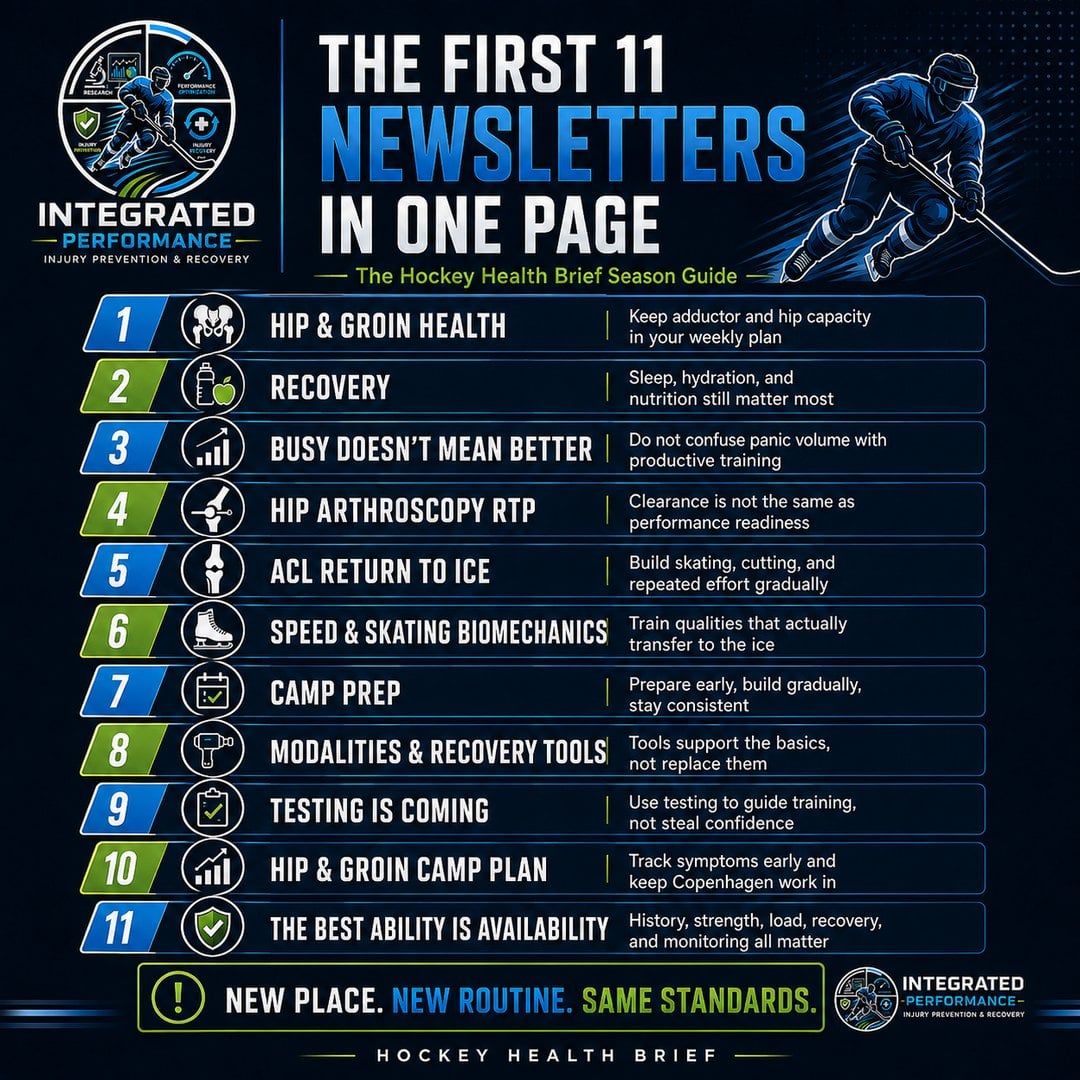
The first 11 Hockey Health Briefs in one page.
|
The first 11 newsletters in one big picture
| Newsletter theme |
Main message |
What to take with you now |
| Hip and groin health |
The hip/groin area is a major performance and injury-prevention area in hockey |
Keep adductor and hip capacity in your weekly plan |
| Recovery |
Recovery is not passive; it drives adaptation |
Sleep, hydration, and nutrition still matter most |
| Busy Doesn’t Mean Better |
More work is not automatically better work |
Do not confuse panic volume with productive training |
| Hip arthroscopy return to play |
Return to play is a progression, not a date |
Clearance is not the same as performance readiness |
| ACL return to ice |
Hockey-specific movement and confidence matter during RTP |
Build back skating, cutting, and repeated effort gradually |
| Speed and skating biomechanics |
Hockey speed depends on force, mechanics, position, and equipment interaction |
Train qualities that actually transfer to the ice |
| Camp preparation |
Last-minute panic is not a plan |
Prepare early, build gradually, stay consistent |
| Modalities and recovery tools |
Tools can help, but they do not replace the basics |
Use recovery tools to support sleep, nutrition, hydration, and load management |
| Testing is coming |
Testing gives information, but it does not define the athlete |
Use testing to guide training, not steal confidence |
| Hip and groin camp plan |
Monitoring and adductor capacity matter before camp volume rises |
Track symptoms early and keep Copenhagen work in |
| The Best Ability Is Availability |
Injury prevention is a system, not one drill |
History, strength, load, recovery, and monitoring all matter |
That is the big picture.
Now let’s simplify it even more.
The five principles that matter most
If an athlete forgot almost everything else and only remembered five things from the whole series, I would want them to remember these.
1. Availability is a performance skill
Being available is not luck.
It is not toughness alone either.
It is built.
It comes from managing workload, building the right physical qualities, recovering well, and responding early when something changes.
A player who is available gets more reps.
A player who gets more reps gets more development.
A player who develops more consistently usually performs better over time.
That is why injury prevention matters.
Not just because injuries are bad.
But because availability creates opportunity.
2. Busy does not mean better
This is still one of the most important ideas from the whole series.
When athletes get anxious, they usually want to do more.
More skates. More lifts. More conditioning. More extra work. More sweat. More soreness.
Sometimes that works for a few days.
Over time, it usually creates fatigue, loss of quality, and a false sense of productivity.
Good training is not just work.
It is work the athlete can adapt to.
That is especially important when moving into training camp, college, juniors, or school-year routines. Those transitions already add stress. If the athlete responds by stacking even more unnecessary work, the body usually pays for it.
3. Hockey players need hockey-specific capacity
Hockey is not just general fitness.
It demands repeated accelerations, decelerations, crossovers, edge control, contact tolerance, trunk control, skating under fatigue, and strength through awkward positions.
That is why the hips, groin, trunk, hamstrings, and single-leg system kept showing up throughout these newsletters.
The player does not just need to be strong.
They need to be strong in ways that support skating and allow them to recover from hockey.
4. Recovery is a system, not a product
This came up over and over again.
The best recovery plan is still built on:
- sleep
- hydration
- nutrition
- appropriate workload
- planned lower-stress recovery
Sauna, compression, cold plunge, red light, and other tools can have a place.
But they are not the foundation.
The foundation is still the boring stuff.
That is actually good news, because it means most athletes already have access to the things that matter most.
5. Small problems are easier to solve than big ones
A lot of hockey issues do not start with a dramatic injury.
They start with a little tightness, soreness that lasts longer, a change in stride, reduced confidence in a movement, sleep starting to drift, fatigue piling up, or extra work without enough recovery.
The best athletes and clinicians do not wait until something becomes a full missed-time problem before acting.
They respond earlier.
That is a huge part of staying available.
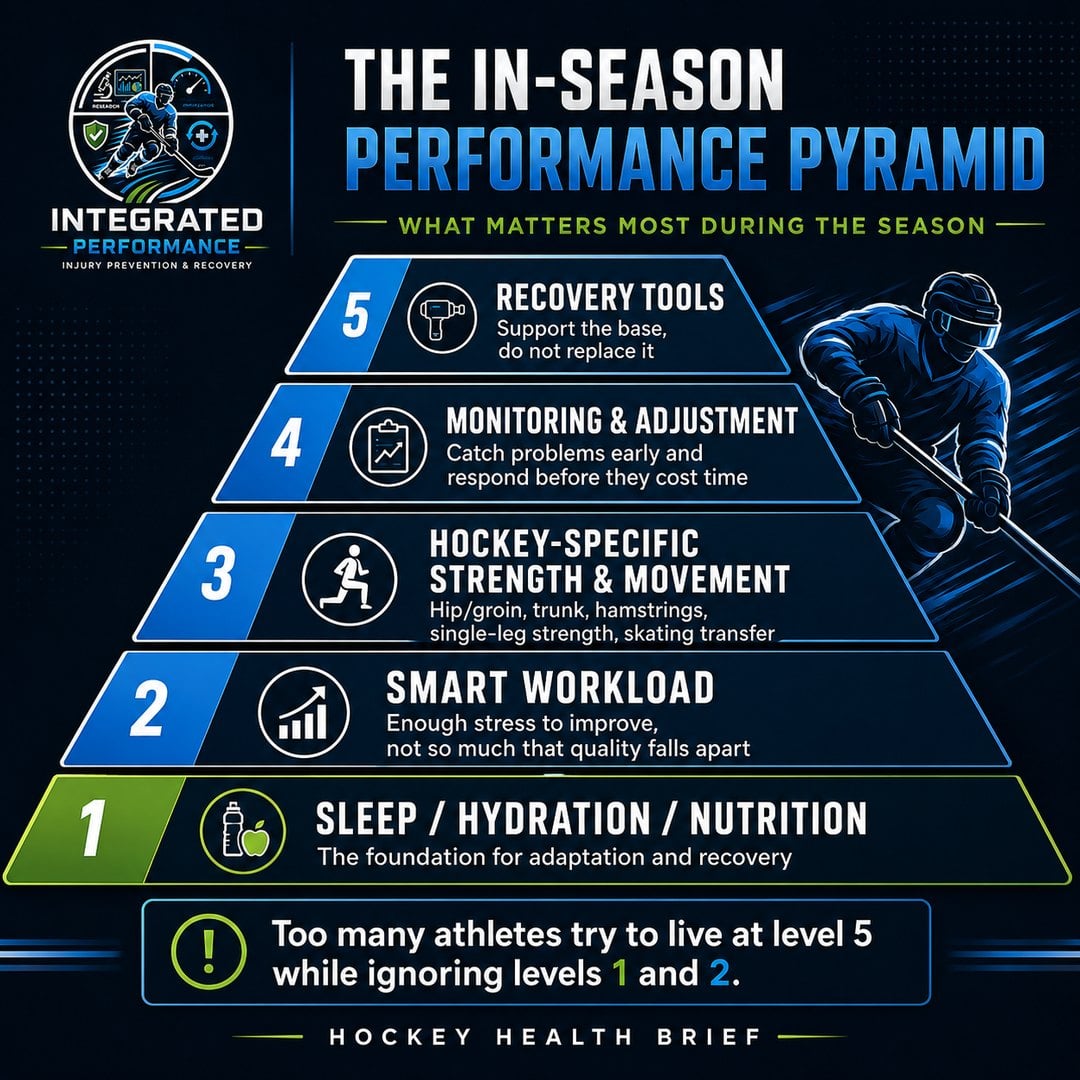
The in-season performance pyramid: the order matters.
|
The in-season performance pyramid
Too many athletes try to live at the top of the pyramid while ignoring the base.
They chase the newest recovery tool, the hardest workout, or the most advanced training method, but they are not sleeping enough, eating enough, hydrating well, or managing their workload.
| Level |
Priority |
What it means |
| 1 |
Sleep / hydration / nutrition |
The foundation for adaptation and recovery |
| 2 |
Smart workload |
Enough stress to improve, not so much that quality falls apart |
| 3 |
Hockey-specific strength and movement |
Hip/groin, trunk, hamstrings, single-leg strength, skating transfer |
| 4 |
Monitoring and adjustment |
Catch problems early and respond before they cost time |
| 5 |
Recovery tools |
Support the base, do not replace it |
Recovery tools can help.
But they do not replace the base.
What athletes should keep doing when life changes
This might be the most practical idea in the whole article.
When athletes leave for college, start school, move to juniors, or head into camp, the environment changes fast. The challenge is not building the perfect system from scratch.
The challenge is keeping the right basics consistent.
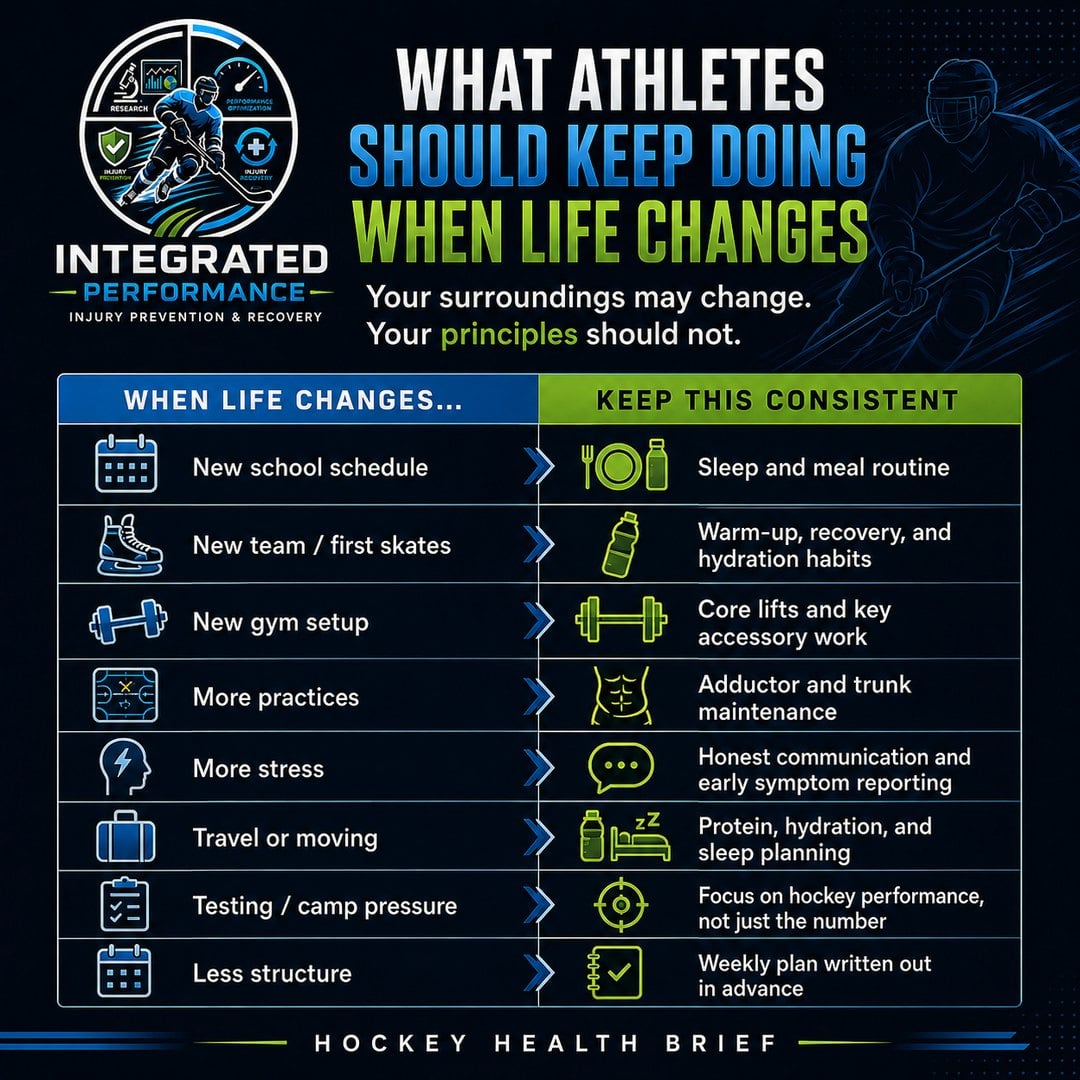
When life changes, the goal is to keep the right basics consistent.
|
| When life changes... |
Keep this consistent |
| New school schedule |
Sleep and meal routine |
| New team / first skates |
Warm-up, recovery, and hydration habits |
| New gym setup |
Core lifts and key accessory work |
| More practices |
Adductor and trunk maintenance |
| More stress |
Honest communication and early symptom reporting |
| Travel or moving |
Protein, hydration, and sleep planning |
| Testing / camp pressure |
Focus on hockey performance, not just the number |
| Less structure |
Weekly plan written out in advance |
|
Your surroundings may change.
|
|
Your principles should not.
|
What a weekly structure should still include
No matter where the athlete is — college, juniors, high school, prep school, training camp, or a new team environment — the weekly structure should still touch the same main buckets.
| Bucket |
What it should include |
| Skating / hockey exposure |
Skill work, practice, pace, repeated effort |
| Strength |
Full-body strength with hockey-specific emphasis |
| Hip/groin maintenance |
Copenhagen progression, adductor work, hip control |
| Posterior chain |
Hamstring and glute work |
| Trunk / single-leg work |
Anti-rotation, carries, split-stance and single-leg strength |
| Recovery |
Sleep, hydration, nutrition, low-intensity recovery |
| Monitoring |
Soreness, fatigue, symptom trends, response to load |
That does not mean every bucket has to be hit hard every day.
It means the week as a whole should still reflect those priorities.
What matters most for athletes leaving for college, juniors, or camp
This is a big transition point, and it is easy to get overwhelmed.
A lot of athletes think the challenge is finding the perfect training plan.
Usually the bigger challenge is protecting the basics when daily life gets less familiar.
Before leaving, an athlete should know:
- what they need in a normal training week
- what their warm-up looks like
- what their recovery routine looks like
- what physical areas tend to need maintenance
- what symptoms they should not ignore
- what good sleep looks like for them
- how to eat enough when routines change
- how to adjust when practices get heavier
- who to communicate with if something starts trending the wrong way
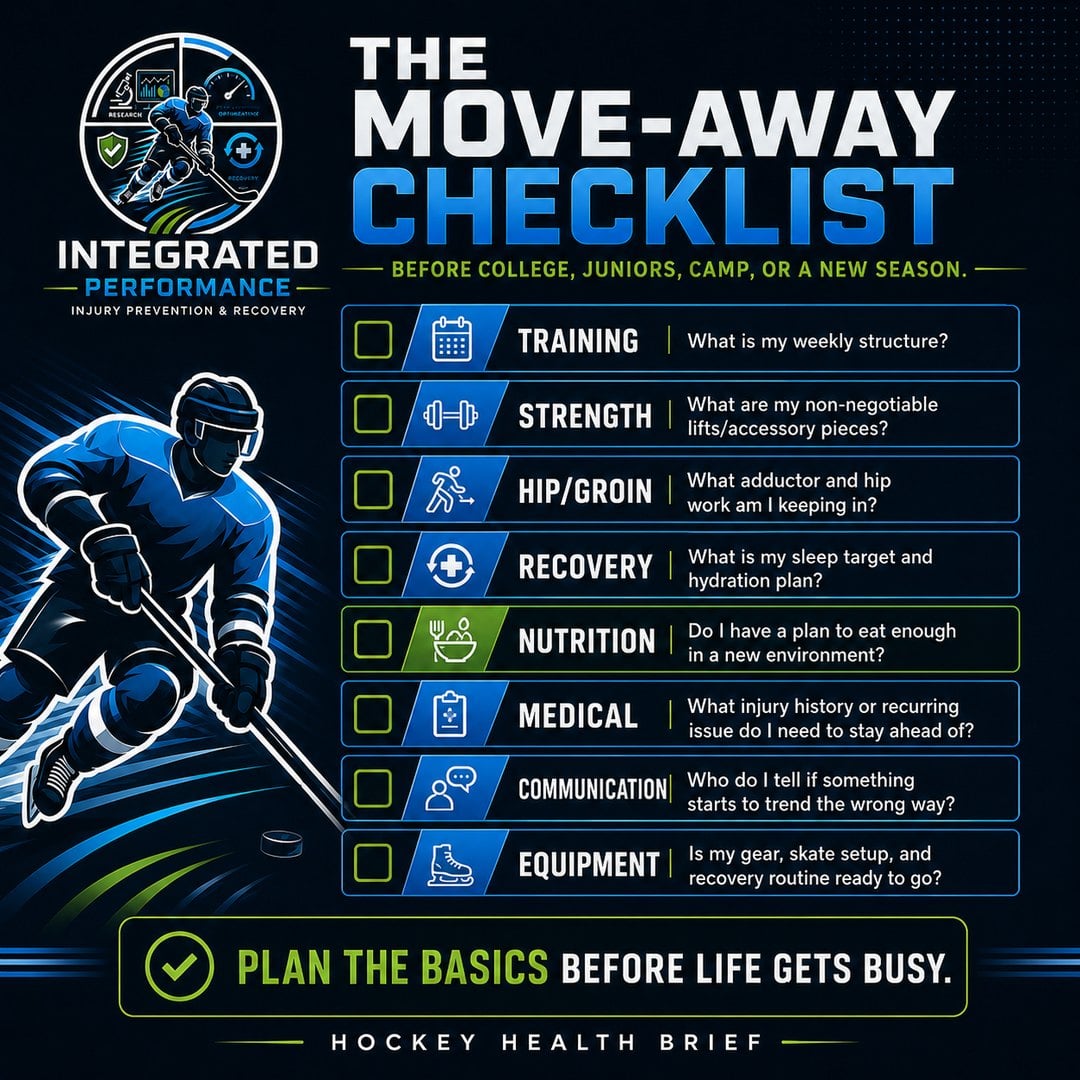
The move-away checklist before college, juniors, camp, or a new season.
|
The move-away checklist
| Category |
Questions to answer before leaving |
| Training |
What is my weekly structure? |
| Strength |
What are my non-negotiable lifts/accessory pieces? |
| Hip/groin |
What adductor and hip work am I keeping in? |
| Recovery |
What is my sleep target and hydration plan? |
| Nutrition |
Do I have a plan to eat enough in a new environment? |
| Medical |
What injury history or recurring issue do I need to stay ahead of? |
| Communication |
Who do I tell if something starts to trend the wrong way? |
| Equipment |
Is my gear, skate setup, and recovery routine ready to go? |
This is especially important because once the season starts, most athletes do not struggle because they care too little.
They struggle because life gets busy and the basics become easier to skip.
The most important carryovers from the injury-prevention newsletter
The injury-prevention issue brought together a lot of evidence, but the simplest carryovers are these:
1. Previous injury still matters
The best screening tool is often a good history.
If something bothered the athlete last year, especially if it changed how they skated, trained, competed, or recovered, it should shape the plan this year.
2. Hip/groin capacity is worth respecting
Especially in hockey.
The hips and groin are not just injury areas. They are skating performance areas.
Keep adductor work, Copenhagen progressions, trunk control, and hip strength in the weekly plan.
3. Workload spikes are predictable
Camp, tournaments, return-to-play phases, school starting, and moving into a full team schedule are all predictable stress points.
Predictable stress points deserve a plan.
4. Sleep and nutrition are not side topics
They are part of the performance and injury-prevention model.
A player cannot adapt to work they are not recovering from.
5. One screen will not predict injury
But good monitoring can guide better decisions.
Track soreness, fatigue, symptoms, sleep, workload, and skating quality over time. A single number rarely tells the whole story, but a pattern usually matters.
What clinicians, coaches, and parents should carry forward
This summary issue is mainly for athletes, but the support system matters too.
| Group |
Main reminder |
| Clinicians |
Do not rely on one screen. Watch trends, symptoms, load, and function together. |
| Coaches |
More is not always better. Availability matters more than winning the warm-up. |
| Parents |
Support routine, food, sleep, and perspective. Not every issue needs panic, but patterns matter. |
| Performance staff |
Build systems athletes can actually sustain once the season gets busy. |
The best support systems make good habits easier to continue.
The one action I would take this week
If I had to narrow the first 11 newsletters down to one action for this week, it would be this:
|
Write out your weekly plan before the week starts.
|
Not a perfect one.
A realistic one.
Include:
- skates
- lifts
- recovery
- food planning
- sleep target
- adductor / hip maintenance
- one check-in point for soreness or fatigue
|
That one habit solves more problems than people realize.
|
It keeps athletes from drifting into reactive mode.
Related reading from the first 11 Hockey Health Briefs
- Hip and Groin Health — for why the hip/groin area matters so much in hockey
- Recovery — for the sleep, hydration, and nutrition foundation
- Busy Doesn’t Mean Better — for workload planning and avoiding panic volume
- Return to Play — for the difference between clearance and performance readiness
- Speed and Skating Biomechanics — for how strength and mechanics transfer to the ice
- Testing Is Coming, But Hockey Is Still the Test — for using testing as information, not identity
- The Hip and Groin Camp Plan — for adductor monitoring and Copenhagen progressions
- The Best Ability Is Availability — for the broader injury-prevention system
The summary in one page
| Principle |
Short version |
| Availability matters |
Healthy athletes get more chances to develop |
| Busy does not mean better |
More work is not always better work |
| Train for hockey |
Build strength and capacity that transfer to the ice |
| Keep hip/groin work in |
It is a performance and durability area |
| Recovery is foundational |
Sleep, hydration, and nutrition still lead |
| Use tools wisely |
Recovery modalities support the basics, not replace them |
| Testing is information |
It should guide training, not define the athlete |
| Watch transitions carefully |
Camps, school, travel, and new routines create predictable stress |
| Monitor small problems early |
Address trends before they become time loss |
| Return to performance matters |
Clearance is not the same as full hockey readiness |
| Keep the principles |
Environment changes, but good principles still work |
The bottom line
The first 11 Hockey Health Briefs were never really about 11 separate topics.
They were about one bigger message.
Help hockey athletes stay available, keep improving, and perform at a high level for a long time.
That means respecting workload, building hockey-specific strength, recovering well, monitoring early, preparing for transitions, and staying consistent with the basics when life gets busy.
As athletes head to school, college, juniors, or training camp, that is what should travel with them.
Not stress.
Not panic.
Not the idea that everything needs to change.
Just the right principles, repeated over time.
|
Available. Prepared. Durable. Ready to play.
|
|