|
Welcome back to the Hockey Health Brief.
As the season gets going, a lot of players are about to spend more time away from home. Road trips, hotels, buses, early departures, late meals, new beds, shared rooms, tournament weekends, and unfamiliar routines all become part of the season.
That is part of hockey.
But playing on the road is not just about showing up to the rink.
It is about how well an athlete can control the pieces they can control when the environment changes.
This week is about building a road routine that supports recovery, sleep, and performance.
|
Newsletter #13
Control the Environment Before the Game Controls You
|
Playing well on the road starts before puck drop.
It starts when the athlete gets off the bus, walks into the hotel, drops the bag in the room, and decides what the next few hours are going to look like.
That window matters.
The road can make everything harder. Sleep is different. Food timing is different. Hydration gets missed. The room is too hot, too bright, or too loud. The athlete sits too long. The pre-game routine gets rushed. Recovery tools get used randomly. The night before the game becomes more about killing time than preparing well.
That does not mean road games have to be a disadvantage.
It means athletes need a plan.
The goal is not to make the road feel exactly like home. That usually is not realistic.
The goal is to build enough familiar structure that the body knows what to do.
|
New rink. New room. Same standards.
|
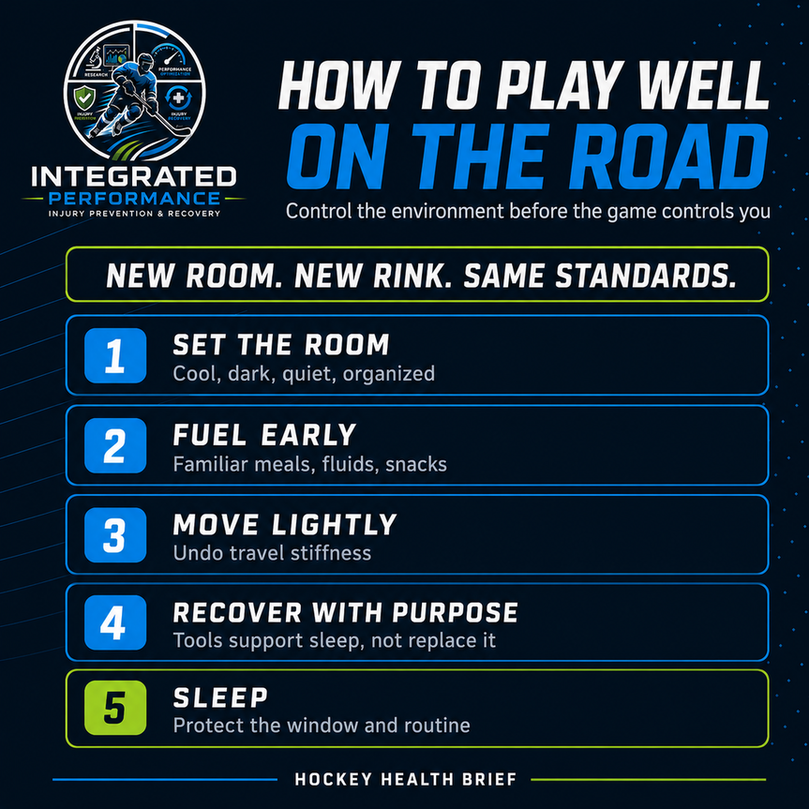
Road game standards: new rink, new room, same standards.
|
The big idea
| Road challenge |
What the athlete can control |
| New bed and hotel room |
Sleep environment, room setup, nighttime routine |
| Travel fatigue |
Movement, hydration, meal timing, light exposure |
| Different schedule |
Written plan for arrival, meals, sleep, and game prep |
| Shared room |
Communication, noise control, lights-out expectations |
| Late arrival |
Simple recovery routine instead of overcomplicating the night |
| Early game |
Prep the room, gear, food, and wake-up plan the night before |
| Game-day nerves |
Familiar warm-up, breathing, and pre-game structure |
| Recovery tools |
Timing and purpose, not random use |
The athlete may not control the hotel, the bus ride, the rink, or the schedule.
But they can control how they respond to it.
Why the road is harder than it looks
Travel can create two different problems: travel fatigue and jet lag.
Travel fatigue can happen even without crossing time zones. It comes from the stress of travel itself: sitting for long periods, disrupted meals, dehydration, poor sleep, schedule changes, and the mental fatigue of being out of routine.
Jet lag is more specific. It happens when athletes cross time zones and the body’s internal clock is no longer aligned with the local schedule.
For many hockey athletes, especially youth, high school, juniors, and college players, the more common problem is not dramatic jet lag. It is the slow build of travel fatigue.
The athlete arrives tired, sits around, snacks randomly, drinks too little, scrolls too long, sleeps poorly, wakes up groggy, and then expects the body to be sharp.
That is a hard way to play well.
Sleep is the foundation of road performance
Sleep is not just recovery.
Sleep supports reaction time, mood, learning, immune function, decision-making, and the ability to adapt to training and competition. Athlete sleep is also especially vulnerable to sport-specific factors like travel, late competition, early training, stress, and unfamiliar environments.[1]
The night before a game matters, but the biggest mistake athletes make is treating that one night like the entire plan.
One perfect night of sleep is not always realistic on the road. Competition anxiety, noise, early event times, bathroom trips, and unfamiliar rooms are common reasons athletes sleep worse than usual before competition.[2]
That is why the goal is not perfection.
|
Protect the sleep window. Protect the room environment. Protect the routine. Protect the morning.
|
The road sleep setup
When an athlete gets into the room, the first job is not to throw the bag down and disappear into the phone.
The first job is to set up the sleep environment.
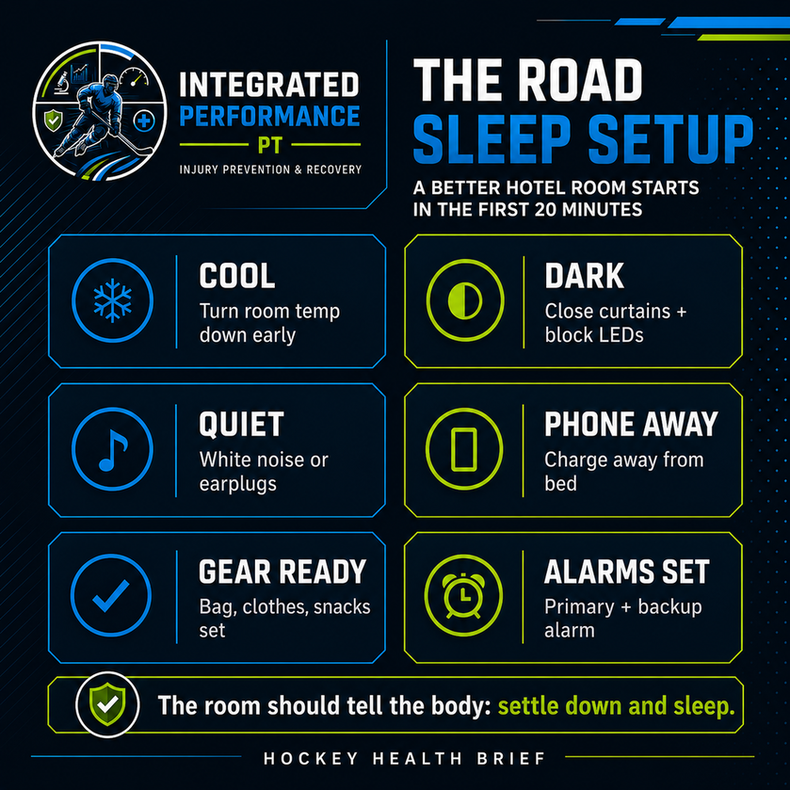
Sleep setup: make the room cool, dark, quiet, and organized before the night gets away.
|
| Room factor |
What to do |
Why it matters |
| Temperature |
Make the room cool and comfortable early |
Temperature and thermal comfort influence sleep quality |
| Light |
Close curtains, block hallway light, cover bright LEDs |
Light exposure at night can disrupt sleep timing and quality |
| Noise |
Use white noise, fan, earplugs, or agreed quiet time |
Hotel noise is one of the most common sleep disruptors |
| Bedding |
Adjust blankets and layers before bed |
Avoid waking up too hot or too cold |
| Phone |
Charge it away from the bed if possible |
Reduces scrolling and late bright-light exposure |
| Alarm |
Set one primary alarm and one backup |
Reduces anxiety about oversleeping |
| Gear |
Lay out clothes, recovery items, and morning needs |
Reduces late-night and morning stress |
A good road room should feel boring.
That is the point.
The room should tell the body: we are safe, we are settled, and we are going to sleep.
The first 20 minutes after arrival
The first 20 minutes after arrival can set the tone for the whole night.
Most athletes either do too much or nothing at all.
The better approach is simple.
| First 20 minutes |
What to do |
| 0–5 minutes |
Put bags down, check the room, turn down temperature, close curtains |
| 5–10 minutes |
Fill water bottle, organize snacks, plug in phone away from bed |
| 10–15 minutes |
Lay out sleep clothes, morning clothes, and game-day essentials |
| 15–20 minutes |
Do a short movement reset: hips, ankles, T-spine, breathing, light mobility |
Travel creates stiffness and fatigue. A short movement reset helps the athlete transition from travel mode to recovery mode.
The arrival-night schedule
Here is a simple mock schedule for an athlete arriving the night before a road game.
Adjust the exact times based on arrival, team meal, curfew, and game time, but keep the order.
Mock schedule: night before a road game
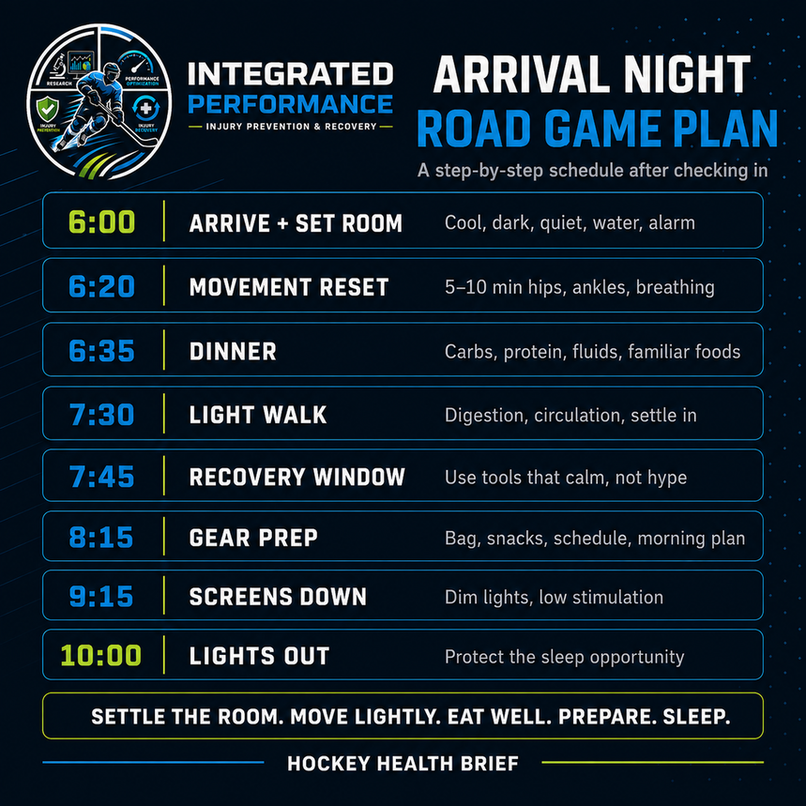
Road game plan: the night-before sequence that turns travel into preparation.
|
| Time |
Action |
Why it matters |
| 6:00 PM |
Arrive at hotel / housing |
Transition from travel to recovery |
| 6:00–6:20 PM |
Set up the room |
Temperature, light, noise, water, gear, alarm |
| 6:20–6:35 PM |
Movement reset |
Undo travel stiffness without creating fatigue |
| 6:35–7:15 PM |
Dinner |
Prioritize carbohydrates, protein, fluids, and familiar foods |
| 7:15–7:45 PM |
Walk / light team movement |
Helps digestion, circulation, and settling |
| 7:45–8:15 PM |
Recovery modality window |
Use tools that calm the system, not tools that hype it up |
| 8:15–8:45 PM |
Gear and game prep |
Pack bag, check sticks/skates, lay out morning needs |
| 8:45–9:15 PM |
Low-stimulation downtime |
Reading, quiet conversation, breathing, music |
| 9:15 PM |
Screens down / lights dim |
Protect sleep onset |
| 9:30–10:00 PM |
Bedtime routine |
Same routine as home when possible |
| 10:00 PM |
Lights out |
Give yourself a real sleep opportunity |
The exact times do not matter as much as the sequence.
Settle the room. Move lightly. Eat well. Recover simply. Prepare the gear. Reduce stimulation. Sleep.
That is the road formula.
Night-before game prep
The night before a road game should not feel chaotic.
Athletes should not be digging through bags at 11:00 PM looking for tape, snacks, socks, chargers, or recovery gear.
The goal is to reduce friction.
| Prep item |
Night-before action |
| Gear |
Check skates, sticks, base layers, socks, tape, mouthguard, and water bottle |
| Nutrition |
Confirm breakfast plan, snack plan, and pre-game meal timing |
| Hydration |
Fill water bottle and begin the next day hydrated |
| Clothing |
Lay out morning clothes and rink arrival clothes |
| Recovery |
Decide what recovery tool is actually being used and when |
| Schedule |
Know wake-up time, meal time, bus time, rink arrival, and puck drop |
| Mindset |
Write or think through one simple performance focus |
| Sleep |
Set room, alarm, and lights-out plan before getting tired |
The night before a game should be boring on purpose.
Boring usually means prepared.
Timing recovery modalities on the road
Recovery tools can help, but timing matters.
The road is where athletes often use modalities randomly. They cold tub because it is available. They use compression boots because someone else is using them. They stretch aggressively because they feel tight. They sit in a hot tub too late because it feels relaxing in the moment.
The better question is:
What does the athlete need right now?
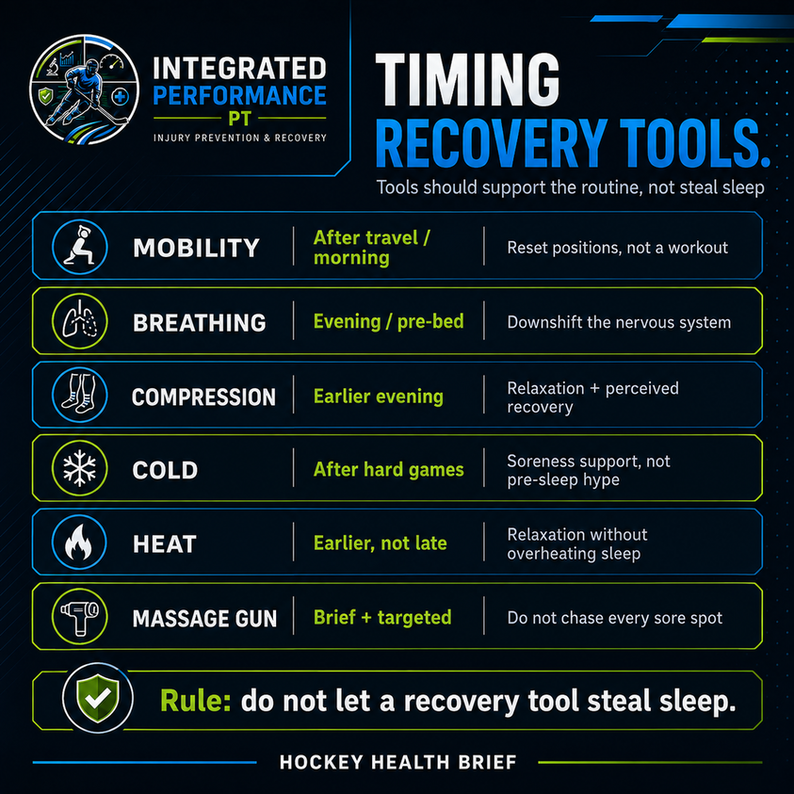
Recovery tools on the road: use the right tool at the right time without stealing sleep.
|
| Tool |
Better timing |
Best use |
Avoid |
| Light mobility |
After travel, before bed, morning of game |
Reduce stiffness and restore positions |
Turning it into a hard workout |
| Breathing / downregulation |
Evening, before bed, after stressful travel |
Calm the nervous system and support sleep |
Using it only after anxiety is already high |
| Compression |
Evening or after hard activity |
Relaxation, circulation, perceived recovery |
Staying up late just to use it |
| Cold exposure |
After hard games or heavy tournaments when soreness is high |
Short-term soreness and recovery support |
Using it right before sleep if it wakes you up |
| Heat / sauna / hot tub |
Earlier evening if used |
Relaxation and warmth |
Long hot sessions late at night that disrupt sleep |
| Stretching |
Short and gentle if needed |
Comfort and positional reset |
Long aggressive stretching into pain |
| Massage gun |
Brief, targeted use |
Reduce perceived tightness |
Chasing every sore spot for 30 minutes |
The rule is simple:
|
Do not let a recovery tool steal sleep.
|
If the choice is 25 more minutes of sleep or a late-night recovery tool, most of the time the athlete should choose sleep.
The warm-up starts before the rink
A good road warm-up starts before the athlete gets to the rink.
The goal is not to replace the team warm-up. The goal is to arrive at the rink already feeling organized, fueled, hydrated, and awake.
| Timing |
Focus |
| Wake-up |
Light, hydration, easy movement |
| Breakfast |
Familiar foods, enough carbohydrates and protein |
| 3–4 hours before game |
Main meal if timing allows |
| 60–90 minutes before warm-up |
Small snack if needed |
| Pre-rink |
Brief mobility / activation if travel stiffness is present |
| Team warm-up |
Raise temperature, activate hips/groin/trunk, sharpen movement |
| On-ice warm-up |
Feel edges, puck, pace, and breathing |
Athletes should avoid making the first few minutes at the rink their first real movement of the day.
A road body often needs a little more time to wake up.
Morning-of-game schedule
Here is a simple morning template for a road game.
Mock schedule: game day on the road
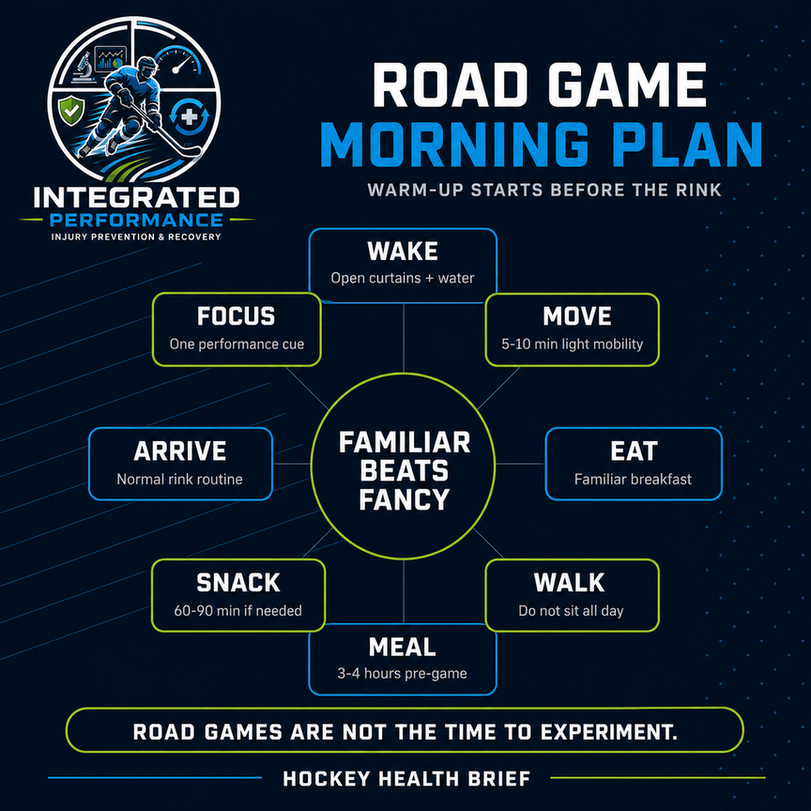
Morning plan: wake up, hydrate, move, fuel, and arrive at the rink ready.
|
| Time |
Action |
Why it matters |
| Wake-up |
Open curtains, get light, drink water |
Helps alertness and circadian timing |
| +10 minutes |
Light movement |
Reduces stiffness from hotel sleep |
| Breakfast |
Familiar meal |
Supports energy without stomach surprises |
| Mid-morning |
Walk, stretch, or team activation |
Keeps the body from getting sluggish |
| 3–4 hours pre-game |
Main meal |
Fuel for the game |
| 90 minutes pre-game |
Small snack / fluids if needed |
Top off without feeling heavy |
| Rink arrival |
Normal routine |
Familiarity lowers stress |
| Team warm-up |
Raise temperature and sharpen movement |
Prepare the body for hockey |
| Pre-game |
One clear focus |
Avoid overthinking |
|
The road is not the time to experiment.
|
|
No new supplements. No new foods. No new caffeine plan. No new stretching routine. No new recovery tool that the athlete has never tried.
|
|
Road performance likes familiarity.
|
What to do if sleep is bad
This is important.
Sometimes the athlete does everything right and still sleeps poorly.
|
That does not mean the game is ruined.
|
A bad night of sleep can happen because of nerves, noise, a new bed, a roommate, a late arrival, or an early game. The athlete should not turn one bad night into a second problem by panicking about it.
The response should be simple:
| Problem |
Better response |
| Bad sleep |
Do not panic; protect the next recovery window |
| Morning grogginess |
Get light, hydrate, move, and eat |
| Midday fatigue |
Consider a short nap if timing allows |
| Heavy legs |
Use light movement, not panic conditioning |
| Anxiety |
Use breathing and one simple performance focus |
| Poor appetite |
Use familiar, easy-to-digest foods |
| Late game |
Avoid long daytime sleeping that disrupts the next night |
Daytime napping can help athletes when used well. Reviews suggest that naps can improve physical and cognitive performance and reduce fatigue, especially when athletes are sleep restricted. A practical option is a short nap earlier in the day, while leaving enough time after waking to avoid sleep inertia before competition.[3,4]
The key is not to chase sleep all day.
The key is to restore just enough alertness without disrupting the next night.
The road athlete checklist
Every athlete should have a travel kit.
Not a massive suitcase of gadgets.
A practical kit that protects sleep, food, hydration, recovery, and game prep.
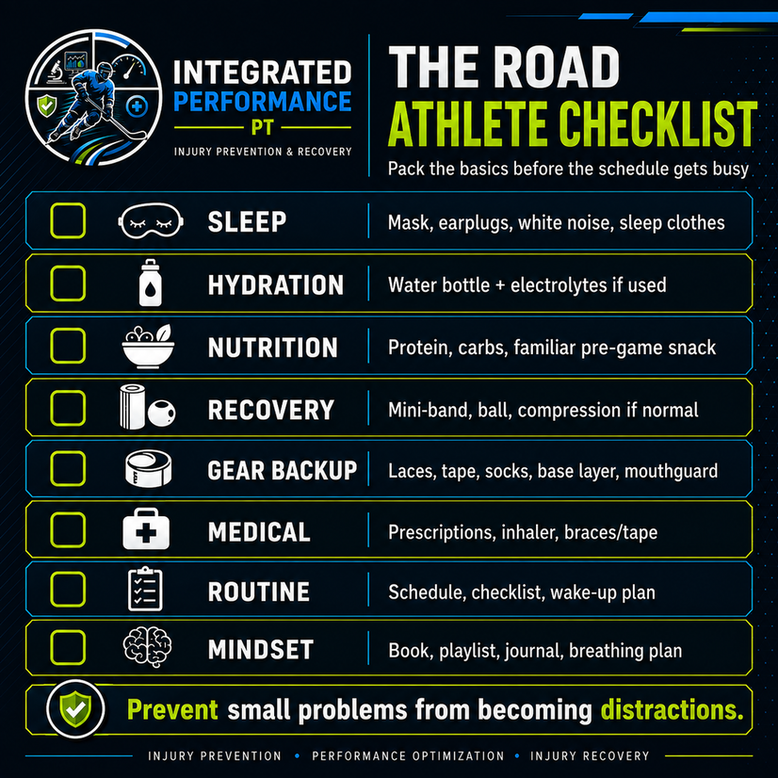
The road athlete checklist: what to travel with for sleep, hydration, nutrition, recovery, gear, and game prep.
|
What to travel with
| Category |
Items |
| Sleep |
Sleep mask, earplugs, small white-noise option, comfortable sleep clothes |
| Room setup |
Phone charger, backup alarm, tape or towel to block small lights if needed |
| Hydration |
Water bottle, electrolytes if used regularly |
| Nutrition |
Protein option, carbohydrate snack, familiar pre-game snack, breakfast backup |
| Recovery |
Small mobility band, lacrosse ball or massage ball, compression if normally used |
| Hygiene |
Toiletries, shower sandals, extra towel if needed |
| Gear backup |
Extra socks, base layer, tape, laces, mouthguard, skate towel |
| Medical |
Any prescribed medications, inhaler if prescribed, braces/tape used regularly |
| Routine |
Written schedule, team itinerary, personal checklist |
| Mental prep |
Book, journal, music playlist, breathing routine, or quiet activity |
The point of the checklist is not to pack everything.
It is to prevent small problems from becoming distractions.
The hotel-room checklist
When the athlete gets into the room, run this checklist before settling in.
| □ | Turn down the room temperature | | □ | Close curtains | | □ | Cover or turn away bright lights | | □ | Set up phone charger away from the bed | | □ | Fill water bottle | | □ | Identify breakfast / snack plan | | □ | Lay out sleep clothes | | □ | Lay out morning clothes | | □ | Check game gear | | □ | Set alarm and backup alarm | | □ | Agree on quiet time with roommate | | □ | Do 5–10 minutes of light movement | | □ | Start wind-down routine on time |
This should take less than 20 minutes.
That is the investment.
Better sleep, lower stress, and better game-day rhythm are the return.
The night-before checklist
Before bed, the athlete should be able to answer these questions:
| □ | Do I know what time I am waking up? | | □ | Do I know when I am eating? | | □ | Do I know when I need to be on the bus or at the rink? | | □ | Is my bag packed? | | □ | Is my water bottle ready? | | □ | Do I have my pre-game snack? | | □ | Is my room cool, dark, and quiet? | | □ | Is my phone away from the bed? | | □ | Have I done something to calm my body down? | | □ | Do I have one simple focus for tomorrow? |
If the answer is yes, the athlete is prepared.
What parents and coaches can do
Road performance is not only on the athlete.
Parents and coaches can make the road easier or harder.
| Group |
Helpful action |
| Parents |
Help athletes pack food, hydration, sleep tools, and backup gear |
| Coaches |
Share schedules early and protect quiet time when possible |
| Captains |
Set room standards and keep the group from turning the hotel into chaos |
| Teammates |
Respect sleep, alarms, lights, and shared space |
| Athletes |
Own the routine and communicate what they need |
The best teams do not treat sleep and recovery like soft extras.
They treat them like part of the preparation.
Key takeaways
| Takeaway |
What it means |
| Road performance starts at arrival |
The first 20 minutes at the hotel matter |
| Sleep is the foundation |
Protect the sleep window, room environment, and routine |
| The room should be set up on purpose |
Cool, dark, quiet, and organized |
| Recovery tools need timing |
Do not let modalities steal sleep |
| Warm-up starts before the rink |
Hydrate, move, eat, and arrive ready |
| Bad sleep is not a disaster |
Respond with light, hydration, food, movement, and smart napping |
| Familiar beats fancy |
Road games are not the time to experiment |
| Pack the basics |
Sleep tools, food, hydration, recovery items, and backup gear |
| Control what you can |
New rink, new room, same standards |
The bottom line
Playing well on the road is not about having the perfect hotel, the perfect meal, the perfect bed, or the perfect schedule.
That rarely happens.
Playing well on the road is about controlling the controllables.
Set up the room. Protect sleep. Eat familiar foods. Hydrate early. Move after travel. Use recovery tools with purpose. Prepare the night before. Warm up before the rink. Pack what you need. Communicate with roommates and teammates. Keep the routine simple enough to repeat.
The athletes who travel well usually do not have the most complicated plan.
They have the clearest one.
That is how you give yourself the best chance to play well on the road.
References
- Walsh NP, Halson SL, Sargent C, et al. Sleep and the Athlete: Narrative Review and 2021 Expert Consensus Recommendations. British Journal of Sports Medicine. 2021;55(7):356–368.
- Juliff LE, Halson SL, Peiffer JJ. Understanding Sleep Disturbance in Athletes Prior to Important Competitions. Journal of Science and Medicine in Sport. 2015;18(1):13–18.
- Lastella M, Halson SL, Vitale JA, et al. To Nap or Not to Nap? A Systematic Review Evaluating Napping Behavior in Athletes and the Impact on Various Measures of Athletic Performance. Nature and Science of Sleep. 2021;13:841–862.
- Petit E, Mougin F, Bourdin H, Tio G, Haffen E. Is Daytime Napping an Effective Strategy to Improve Sport-Related Cognitive and Physical Performance and Reduce Fatigue? A Systematic Review and Meta-Analysis of Randomised Controlled Trials. British Journal of Sports Medicine. 2023;57(7):417–426.
- Janse van Rensburg DC, Jansen van Rensburg A, Fowler PM, et al. Managing Travel Fatigue and Jet Lag in Athletes: A Review and Consensus Statement. Sports Medicine. 2021;51(10):2029–2050.
- Kellmann M, Bertollo M, Bosquet L, et al. Recovery and Performance in Sport: Consensus Statement. International Journal of Sports Physiology and Performance. 2018;13(2):240–245.
- Vitale KC, Owens R, Hopkins SR, Malhotra A. Sleep Hygiene for Optimizing Recovery in Athletes: Review and Recommendations. International Journal of Sports Medicine. 2019;40(8):535–543.
- Zhao Y, Sun J, Liu X, et al. Effects of Cold Water Immersion After Exercise on Fatigue Recovery and Exercise Performance: Meta-Analysis. Frontiers in Physiology. 2023;14:1006512.
|